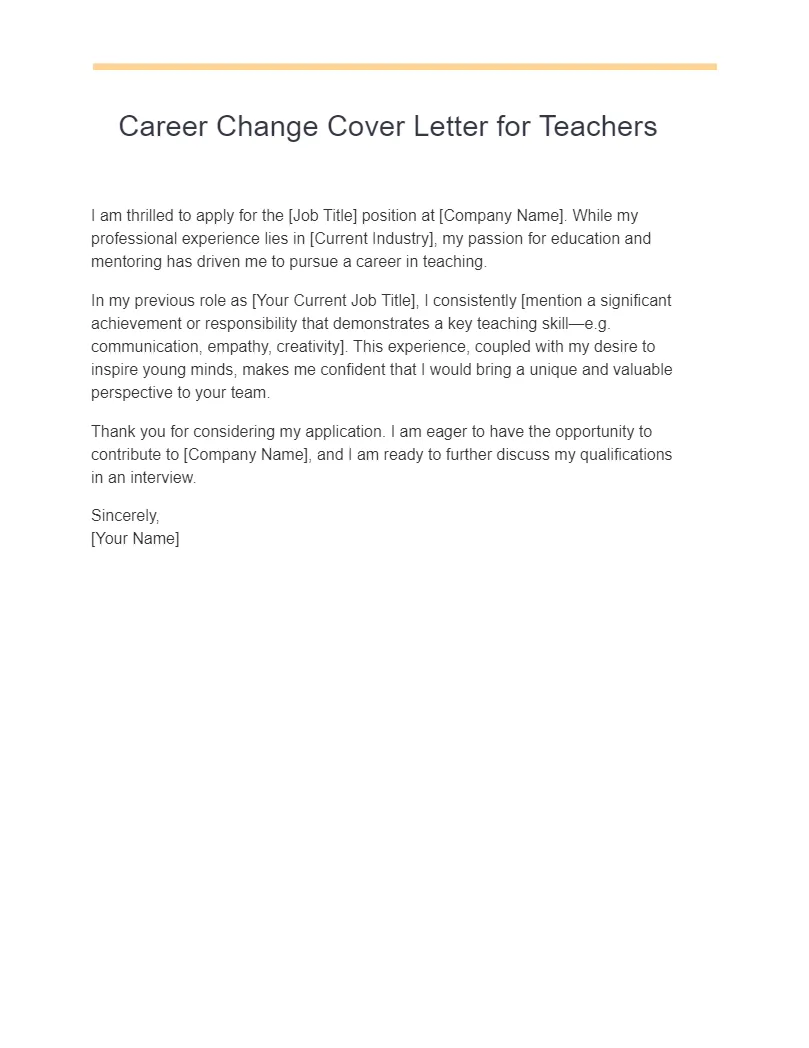
Why a Cover Letter Matters for Career Changers
Embarking on a career change to teaching is a significant step, and a well-crafted cover letter can be your most powerful tool. Unlike a resume, which provides a static overview of your experience, a cover letter allows you to narrate your story, explain your motivations, and directly address the concerns a hiring manager might have about your transition. It offers a space to highlight your transferable skills, demonstrate your passion for teaching, and illustrate how your unique background makes you a valuable candidate. In a competitive field like education, where many applicants might have similar qualifications, a compelling cover letter can be the deciding factor in securing an interview. It’s your opportunity to stand out, personalize your application, and showcase your genuine interest in the specific teaching role and school. The cover letter becomes particularly crucial for career changers, as it bridges the gap between your previous experience and your aspirations in education, making your application more relatable and convincing.
Highlighting Transferable Skills
One of the most important aspects of a career change cover letter is emphasizing your transferable skills. These are the skills you’ve gained in your previous roles that are directly applicable to teaching. Identify these skills and provide specific examples of how you’ve used them. Examples can include communication, leadership, problem-solving, organization, time management, and the ability to work with diverse groups of people. For example, if you previously managed projects, highlight how you developed organizational skills, managed deadlines, and coordinated teams – all essential for classroom management and lesson planning. If you worked in a customer service role, discuss your ability to communicate effectively, resolve conflicts, and build rapport – qualities vital for interacting with students, parents, and colleagues. Tailor your examples to the specific teaching role you’re applying for and the requirements listed in the job description. Demonstrating how your skills translate to the classroom environment will reassure the hiring manager that you can succeed in this new career path.
Identifying Relevant Experience

Even if you don’t have direct teaching experience, you likely have relevant experience that can be showcased in your cover letter. Think about volunteer work, mentoring roles, training or presentation experiences, or any situations where you’ve worked with children or adults in a teaching or guiding capacity. Describe these experiences in detail, highlighting the skills you used and the outcomes you achieved. For instance, if you’ve volunteered at a youth center, describe the activities you led, the age group you worked with, and any positive feedback you received. If you’ve conducted training sessions at your previous job, detail your preparation process, your delivery style, and how you adapted your approach to different learners. Even seemingly unrelated experiences can be framed to demonstrate your suitability for teaching. For example, if you have experience in a field that requires strong communication or problem-solving skills, explain how those skills will help you effectively manage a classroom and support student learning. The goal is to demonstrate to the hiring manager that you’re familiar with a classroom environment.
Tailoring Your Cover Letter to Teaching
A generic cover letter won’t suffice when you’re seeking a career change into teaching. Tailoring your cover letter to the specific teaching role and school is essential. Start by carefully reviewing the job description and identifying the key requirements and desired qualifications. Then, in your cover letter, explicitly address how your skills and experience align with those requirements. Use the same keywords and phrases from the job description to show that you understand the needs of the position and are a good fit for the school’s culture. Also, consider what aspects of the school’s mission or values resonate with you. Demonstrate your understanding of the school’s educational philosophy, its student population, and the types of programs it offers. Customizing your cover letter to the specific role and school demonstrates your genuine interest and that you have invested time and effort to understand their needs. This personalization significantly increases your chances of getting noticed and being invited for an interview.
Researching the School and its Needs
Before you start writing your cover letter, conduct thorough research on the school where you’re applying. Visit the school’s website, read its mission statement, and review any information about its programs, values, and student demographics. If possible, look for information about the school’s teaching philosophy or the specific curriculum they follow. This research will help you tailor your cover letter to resonate with the school’s specific needs and demonstrate your genuine interest. In your cover letter, you can mention something specific about the school that excites you or how your skills and experience would contribute to their goals. For instance, you might mention an innovative teaching approach or a specific program that aligns with your interests. This proactive approach shows the hiring manager that you are passionate about the teaching and are eager to become a part of their community. Researching the school demonstrates that you have taken the time to understand the school’s culture and priorities.
Structuring Your Cover Letter

A well-structured cover letter is easy to read and highlights your key qualifications effectively. A standard format typically includes a header with your contact information, the date, and the hiring manager’s contact information. Begin with a compelling opening paragraph that grabs the reader’s attention and states your interest in the position. The following paragraphs should detail your relevant experience and highlight your transferable skills, always providing specific examples to support your claims. Be sure to address the career change directly, explaining why you are switching to teaching and what motivates you. Conclude with a strong closing paragraph that reiterates your interest and includes a clear call to action, such as requesting an interview. Throughout your cover letter, maintain a professional tone and use clear, concise language. Break up long paragraphs into shorter, more readable sections. The structure should demonstrate your organizational skills and your understanding of what hiring managers are looking for in a candidate.
The Header Your Contact Information
The header of your cover letter should include your name, address, phone number, and professional email address. Ensure that your contact information is accurate and up-to-date. Use a clear and professional font and style. The header should be easy to find at the top of your cover letter. It allows the hiring manager to quickly identify you and easily contact you. Double-check all details to make sure there are no errors. If you have a LinkedIn profile, you can include a link to it in the header. This allows the hiring manager to learn more about your background and professional network. Keeping your header clear and professional sets the tone for the rest of your cover letter and shows that you pay attention to details. It’s often the first thing a hiring manager sees, so make a good impression.
The Salutation Addressing the Hiring Manager
Always address the hiring manager by name if possible. Research the school’s website or use LinkedIn to find the name of the person responsible for hiring. A personalized salutation, such as “Dear Mr. or Ms. [Last Name],” shows that you have taken the time to research and personalize your application. If you are unable to find a specific name, use a professional alternative, such as “Dear Hiring Committee” or “Dear [Department] Hiring Manager.” Avoid using generic salutations like “To Whom It May Concern” or “Dear Sir/Madam.” The salutation sets the tone for the entire letter. Personalizing it shows initiative and attention to detail. If the job posting does not provide contact information, try calling the school’s main office or checking the staff directory on their website to find the hiring manager’s name.
Opening Paragraph Grabbing Their Attention

The opening paragraph is your chance to grab the hiring manager’s attention and immediately communicate your enthusiasm for the position. State the specific teaching role you are applying for and briefly mention how you learned about the opportunity. Then, in one or two sentences, summarize your key qualifications and why you are excited about the position and the school. For example, you might say, “I am writing to express my keen interest in the [Job Title] position at [School Name], as advertised on [Platform]. With my [Number] years of experience in [Previous Field] and my passion for fostering a positive and engaging learning environment, I am confident that I can make a significant contribution to your school community.” This concise introduction quickly establishes your purpose and highlights your key strengths. Avoid generic opening lines. The first paragraph should convey both your interest and what makes you a valuable candidate, sparking the hiring manager’s interest.
Body Paragraphs Showcasing Your Skills
The body paragraphs of your cover letter are where you elaborate on your qualifications and demonstrate how your skills and experience align with the requirements of the teaching role. Focus on showcasing your transferable skills, providing concrete examples from your previous work or volunteer experiences. Use the STAR method (Situation, Task, Action, Result) to structure your examples. Describe the situation you faced, the task you were assigned, the actions you took, and the results you achieved. Quantify your accomplishments whenever possible. For example, instead of saying “I improved customer satisfaction,” say “I increased customer satisfaction by 15% through implementing a new training program.” Tailor your examples to the specific requirements mentioned in the job description. This shows the hiring manager that you understand the needs of the position and have the skills necessary to succeed. Each paragraph should address a particular skill or experience, backed up with evidence. Focus on what you can bring to the school and the classroom environment.
Highlighting Your Accomplishments
Highlighting your accomplishments is a critical part of demonstrating your value to a potential employer. Instead of simply listing your responsibilities, focus on the achievements you’ve made in your previous roles. Use action verbs to describe your contributions. For instance, use words like “managed,” “developed,” “implemented,” “achieved,” and “led.” Quantify your accomplishments whenever possible by using numbers, percentages, or other metrics to show the impact of your work. For example, instead of saying “Improved team efficiency,” you could say “Increased team efficiency by 20% through the implementation of a new workflow system.” The impact of your accomplishments, and the skills you have that help you to achieve, should be directly relevant to the job you are applying for. The examples in your cover letter can clearly show that you are results-oriented. Be clear and concise.
Using Keywords in Your Cover Letter

Use keywords from the job description throughout your cover letter. Applicant Tracking Systems (ATS) often scan cover letters for keywords to filter out unqualified candidates. Carefully review the job description and identify key terms and phrases related to the skills, experience, and qualifications the employer is seeking. Incorporate these keywords naturally into your cover letter. For example, if the job description mentions “classroom management,” “differentiated instruction,” and “student assessment,” include these terms in your cover letter when discussing your relevant experience. Avoid keyword stuffing, which can make your letter sound unnatural and insincere. Make sure that you use the keywords in a way that makes sense and that reflects your actual skills and experience. By using the right keywords, you increase the likelihood that your cover letter will be noticed by the hiring manager and that you’ll get an interview.
Addressing the Career Change
Addressing your career change directly and transparently is crucial for career changers. Explain your reasons for transitioning to teaching and what has drawn you to this profession. Highlight any experiences that sparked your interest in education or your passion for working with children or students. Focus on the transferable skills you gained in your previous career that make you a strong candidate. For example, if you’re changing from a management role, you can highlight leadership, communication, and organizational skills, which are valuable in a classroom setting. Avoid using negative language about your previous career or the reasons for leaving it. Instead, focus on the positive aspects of teaching and how you’re motivated to make a difference in students’ lives. Express your enthusiasm for this new direction. Hiring managers will appreciate your honesty and your clear explanation of why you’re choosing education. Be sure to showcase your passion and commitment to teaching.
The Closing Paragraph and Call to Action
The closing paragraph of your cover letter should summarize your interest and reiterate your qualifications. Restate your enthusiasm for the teaching position and your eagerness to contribute to the school’s community. Include a clear call to action, such as requesting an interview. For example, you might write, “Thank you for considering my application. I am eager to learn more about this opportunity and discuss how my skills and experience can benefit your school. I am available for an interview at your earliest convenience.” Provide your contact information again. Always end the cover letter on a positive and confident note, expressing your gratitude for the hiring manager’s time and consideration. Proofread your closing paragraph to ensure there are no errors.
Proofreading and Editing Your Cover Letter

Proofreading and editing your cover letter is a critical step in ensuring it is polished and professional. Errors in grammar, spelling, and punctuation can undermine your credibility and make a negative impression on the hiring manager. Read your cover letter carefully several times, looking for any mistakes. Use spell-check and grammar-check tools, but don’t rely on them entirely; these tools often miss subtle errors. Ask a friend, family member, or career advisor to proofread your cover letter. A fresh pair of eyes can often catch errors that you might have missed. Review your cover letter to ensure that the language is clear, concise, and professional. Remove any unnecessary jargon or overly complex sentences. Make sure that the tone of your cover letter is appropriate for the teaching profession and the school. Proofreading and editing demonstrates your attention to detail and commitment to quality. Always make sure your cover letter is error-free to make the best possible impression.
Ensuring a Professional Tone and Format
Maintaining a professional tone and format is essential for your cover letter. Use a clear and easy-to-read font, such as Times New Roman, Arial, or Calibri, in a standard size. Avoid using excessive formatting, such as bolding too much text or using multiple fonts. Use business letter format with appropriate margins, spacing, and indentation. Ensure your language is professional and formal. Avoid using slang, jargon, or casual language. Proofread your cover letter carefully for any errors in grammar, spelling, and punctuation. A professional tone conveys your respect for the hiring manager and the school. A well-formatted cover letter demonstrates your attention to detail and professionalism. Always create a good first impression and highlight your best attributes.
Common Mistakes to Avoid
Several common mistakes can undermine your cover letter and reduce your chances of getting an interview. Avoid using a generic cover letter that is not tailored to the specific teaching position or school. Ensure that your cover letter is free of grammatical errors and typos. Do not focus solely on your past experience without clearly explaining how it relates to teaching and the specific job. Do not include irrelevant information or personal details that are not related to the teaching role. Never speak negatively about your previous employer or any past professional experiences. Avoid being overly wordy or using jargon. Always make sure your cover letter is clear, concise, and easy to read. Proofread carefully to make sure that your cover letter demonstrates your interest in teaching, your qualifications, and your commitment to the school’s mission.