Top 5 Teacher Cover Letter Secrets
Securing a teaching position is a competitive process, and your cover letter is your first chance to make a positive impression. It’s more than just a formality; it’s a crucial tool for showcasing your qualifications, passion, and suitability for the role. This article uncovers the top five secrets to crafting a cover letter that captures the attention of principals and hiring managers, setting you apart from other applicants. By focusing on these key elements, you can significantly increase your chances of landing an interview and ultimately, your dream teaching job. Each secret is designed to provide actionable insights, transforming your cover letter from a generic document into a compelling narrative that highlights your unique value as an educator. Getting the cover letter right is the key for opening the door for the first conversation, and this article equips you to write a cover letter that does just that.
Highlighting Your Teaching Skills
Your teaching skills are the core of your profession, so they must be presented clearly and convincingly. Begin by identifying the key skills the school values, such as classroom management, lesson planning, differentiated instruction, and assessment. Then, provide concrete examples of how you’ve successfully applied these skills in previous teaching roles. Instead of simply listing your skills, demonstrate them through specific anecdotes. For instance, describe a challenging classroom situation you managed effectively, or a lesson plan you created that led to improved student outcomes. Quantify your achievements whenever possible. Did your innovative teaching methods increase student engagement by a certain percentage? Did your assessment strategies lead to higher test scores? By emphasizing your skills and backing them up with tangible evidence, you prove to the hiring manager that you possess the expertise to excel in the role.
Showcasing Your Experience

Your experience is a key factor in your candidacy. In your cover letter, detail your teaching experience in a way that immediately grabs the reader’s attention. Begin with a brief overview of your experience, including the number of years you’ve taught and the grade levels or subjects you’ve specialized in. Then, delve into specific roles you’ve held, highlighting the key responsibilities and achievements associated with each one. Focus on your most relevant experiences and those that align with the specific requirements of the job. For example, if the school emphasizes its commitment to inclusive education, be sure to highlight your experience working with diverse student populations or implementing inclusive teaching strategies. Use the STAR method (Situation, Task, Action, Result) to structure your examples. Describe the situation you faced, the task you were assigned, the actions you took, and the positive results you achieved. This approach provides a clear and concise narrative that showcases the impact of your experience.
Emphasizing Your Passion for Education
A genuine passion for education is contagious and a significant asset in the classroom. Your cover letter is an opportunity to convey your enthusiasm for teaching. Share what motivates you to teach, what you find most rewarding about working with students, and what you hope to accomplish in your career. Avoid clichés and instead, be authentic. Do you believe in fostering a love of learning? Are you driven by a desire to make a difference in the lives of your students? Explain why you’re passionate about the school’s mission and values. Show that you’ve done your research on the school and share how your passion aligns with its goals. This might involve mentioning a specific program or initiative that resonates with you or describing how you can contribute to the school’s culture of learning. By showcasing your genuine passion, you will not only make a memorable impression but also convince the hiring manager that you’re the right fit for the school community.
Tailoring Your Letter to the School
A generic cover letter will not get you the job. Taking the time to tailor your cover letter to each specific school is essential. This demonstrates that you are genuinely interested in the position and have taken the initiative to learn about the school’s unique needs and culture. Start by researching the school’s website, mission statement, and recent news to gain insights into its values, programs, and priorities. Identify how your skills and experiences align with the school’s specific requirements. If the school emphasizes project-based learning, highlight your experience with similar teaching methodologies. If they are committed to incorporating technology in the classroom, mention your proficiency with relevant educational tools. Address your cover letter to the hiring manager or principal by name. This personal touch indicates that you have put in the effort to learn about the school and shows your attention to detail. The most important thing is to illustrate how you can contribute to the school’s success and help its students thrive.
Using Action Verbs to Describe Your Accomplishments

Action verbs are essential for creating a dynamic and compelling cover letter. These verbs not only make your writing more engaging but also provide concrete examples of your accomplishments and skills. Avoid passive language and instead, use strong action verbs to highlight your achievements. Instead of writing “I was responsible for lesson planning,” use a verb like “Developed lesson plans that…” This immediately gives the reader a better picture of your role and accomplishments. Start each bullet point or paragraph describing your responsibilities and accomplishments with a powerful action verb. Examples include: “Created,” “Implemented,” “Managed,” “Led,” “Developed,” “Collaborated,” “Assessed,” and “Improved.” Remember to quantify your results whenever possible. For instance, “Increased student test scores by 15%” or “Reduced classroom disruptions by 20%.” By using action verbs and quantifiable results, you provide concrete evidence of your effectiveness as a teacher, making your cover letter significantly more impactful.
Cover Letter Format for Teacher Application
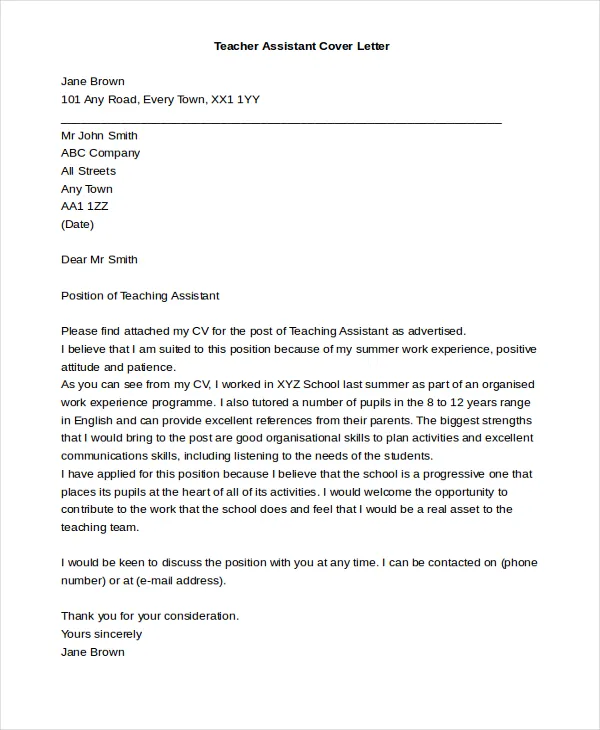
A well-formatted cover letter is just as important as the content. The format of your cover letter reflects your professionalism and attention to detail. Start by choosing a professional font, such as Times New Roman, Arial, or Calibri, and maintain a consistent font size throughout the document. Use standard 1-inch margins and single-space your text, leaving a blank line between paragraphs for readability. The cover letter should be concise, typically no more than one page in length. Use clear headings and subheadings to organize your thoughts and guide the reader through the document. Ensure the letter is free of grammatical errors and typos. Proofread carefully before submitting your application. To ensure the best presentation, save your cover letter as a PDF file. This ensures that your formatting remains consistent across different devices and operating systems, providing a professional and polished appearance. A well-formatted cover letter shows that you care about details, an important quality for a teacher.
Header Details and Salutation
Begin your cover letter with a professional header that includes your contact information: your full name, phone number, email address, and optionally, your LinkedIn profile URL. Directly below your information, include the date and the recipient’s information. Address the cover letter to the hiring manager or principal by name if possible. Research the school’s website or LinkedIn to find the correct name and title. The salutation should be formal, such as “Dear Mr./Ms. [Last Name].” Avoid generic greetings such as “To Whom It May Concern.” Using the correct name shows that you have done your research and are genuinely interested in the position. This also makes a more personal connection with the reader from the outset. Ensure all contact information is accurate and up to date. A professional header and personalized salutation are the first step in making a positive impression and setting the tone for your application.
Body Paragraphs: The Core of Your Letter

The body paragraphs are where you make your case for why you are the best candidate. Typically, the body of your cover letter should include three to four paragraphs. The first paragraph should state the position you are applying for and briefly mention where you saw the job posting. In the second paragraph, highlight your key skills and experiences. Provide specific examples to demonstrate your qualifications. In the third paragraph, explain why you are a good fit for the school. Discuss your understanding of the school’s mission, values, and culture, and how your teaching philosophy aligns with theirs. The fourth paragraph, if needed, can be used to offer any additional information or insights that you believe are relevant. Keep each paragraph concise and focused. Use clear and concise language, and avoid jargon or overly complex sentences. By structuring your body paragraphs thoughtfully and using clear language, you will keep your cover letter focused and easy to read.
Closing Your Cover Letter
Your closing paragraph should express your interest in the position and thank the hiring manager for their time and consideration. Reiterate your enthusiasm for the opportunity and briefly mention your readiness for an interview. Include a call to action, such as “I am eager to discuss my qualifications further” or “I look forward to hearing from you soon.” End with a professional closing, such as “Sincerely” or “Best regards,” followed by your full name. Proofread the entire letter one last time to catch any typos or grammatical errors. A well-crafted closing paragraph leaves a lasting positive impression, emphasizing your professionalism, and making it easier for the hiring manager to take the next step, which is to call you for an interview. This closes the loop on your application, reinforcing your interest, and facilitating further contact.
Proofreading and Editing Your Cover Letter
Before submitting your cover letter, proofreading and editing are essential steps. Errors in grammar, spelling, and punctuation can undermine your professionalism and credibility. Begin by carefully reviewing your cover letter for any obvious errors. Use a grammar and spell-checking tool. However, don’t rely solely on these tools; they may miss subtle errors. Read your cover letter aloud to catch any awkward phrasing or sentences that don’t flow smoothly. Have a friend or mentor review your letter. A fresh pair of eyes can spot errors you might have missed. Pay attention to the overall tone and flow of your letter. Does it sound enthusiastic, professional, and tailored to the school? Ensure your writing is clear and concise. Eliminate any unnecessary words or phrases. Confirm your contact information is accurate. Make sure your name, phone number, and email address are correct. Proofreading and editing are vital steps in ensuring your cover letter effectively represents your qualifications and increases your chances of getting hired.
In conclusion, crafting a compelling teacher cover letter is an art that requires careful attention to detail and strategic planning. By focusing on your teaching skills, showcasing your experience, emphasizing your passion for education, and tailoring your letter to the school, you significantly increase your chances of success. Remember to use action verbs, format your letter professionally, and proofread meticulously. Use the secrets outlined in this article, and your cover letter will become your most powerful tool in your job search. With a well-written cover letter, you’ll not only capture the attention of hiring managers, but you’ll also pave the way for an interview and ultimately, the opportunity to secure your dream teaching position.