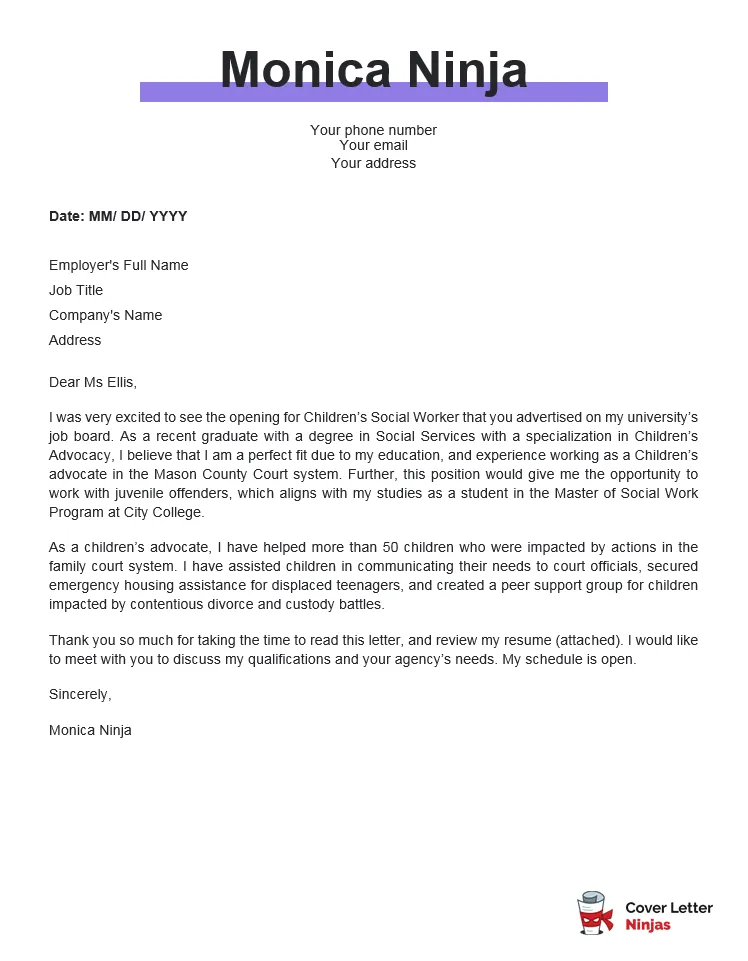
Crafting a Social Work Cover Letter
A well-crafted social work cover letter is your first opportunity to make a strong impression on potential employers. It serves as an introduction, showcasing your skills, experience, and passion for the field. Unlike a resume, which provides a factual overview of your qualifications, a cover letter allows you to express your personality, explain your motivations, and demonstrate how your specific skills align with the job requirements and the organization’s values. This guide will walk you through the essential steps of creating a compelling cover letter that will help you stand out from the competition and land your dream social work job. The goal is to highlight your unique qualifications and to show why you are the perfect fit for the position.
Understanding the Purpose of a Cover Letter
The primary purpose of a cover letter is to convince the hiring manager to read your resume. It’s your chance to provide context for your qualifications, explain your career goals, and express your enthusiasm for the position and the organization. It should not simply reiterate your resume; instead, it should expand on your achievements, illustrate your key skills with concrete examples, and articulate why you are a good fit for the specific job. A strong cover letter demonstrates your understanding of the social work field and your commitment to making a difference in the lives of others. It should be tailored to each position, highlighting the most relevant skills and experiences.
Highlighting Your Qualifications

When highlighting your qualifications, focus on the skills and experiences that directly align with the job description. Review the job posting carefully and identify the key requirements. Then, provide specific examples of how you have demonstrated those skills in previous roles or during your education. Use action verbs to describe your accomplishments and quantify your achievements whenever possible. For instance, instead of saying “Provided counseling services,” you might say “Provided individual and group counseling services to over 50 clients, resulting in a 20% improvement in their coping skills.” This approach makes your qualifications more compelling and demonstrates your ability to achieve results.
Skills to Showcase on Your Cover Letter
Social work requires a diverse set of skills. Some key skills to showcase in your cover letter include communication, empathy, critical thinking, problem-solving, advocacy, and cultural competence. You should also demonstrate strong interpersonal skills, the ability to work independently and as part of a team, and a commitment to ethical practice. Provide examples of how you have utilized these skills in previous roles. For instance, you might describe how you effectively communicated with clients from diverse backgrounds, used critical thinking skills to assess a complex situation, or advocated for a client’s needs within a bureaucratic system.
Experience and Achievements
In addition to highlighting your skills, showcase your relevant experience and achievements. Describe your previous roles and responsibilities, focusing on accomplishments rather than simply listing your duties. Use the STAR method (Situation, Task, Action, Result) to provide detailed examples of your achievements. For example, if you improved a program’s efficiency, explain the situation, the task you undertook, the specific actions you took, and the positive results achieved. This demonstrates your ability to make a tangible impact. Also, highlight any volunteer work, internships, or other experiences that demonstrate your commitment to social work and your relevant skills.
Tailoring Your Cover Letter

A generic cover letter is unlikely to impress a hiring manager. To make your cover letter stand out, tailor it to each specific job and organization. This involves carefully reviewing the job description and identifying the key requirements and desired qualifications. Research the organization’s mission, values, and the population it serves. Then, customize your cover letter to reflect your understanding of the organization and demonstrate how your skills and experience align with its specific needs. Show that you have taken the time to understand the opportunity and that you are genuinely interested in the position.
Researching the Organization
Before writing your cover letter, thoroughly research the organization. Visit its website, read its mission statement, and learn about its programs and services. Understand the population it serves and the specific challenges it addresses. If possible, read news articles or publications related to the organization. This research will allow you to demonstrate your genuine interest in the organization and its work. It will also help you tailor your cover letter to highlight your qualifications in a way that aligns with the organization’s needs and values. This level of preparation will make a positive impression on the hiring manager.
Formatting Your Cover Letter
The format of your cover letter is crucial. It must be clean, professional, and easy to read. Use a standard font such as Times New Roman, Arial, or Calibri in a readable size (11 or 12 points). Ensure there are clear margins (1 inch on all sides) and use single-spaced lines with a space between each paragraph. The layout should be visually appealing and organized. Use headings and bullet points to make your content more scannable and accessible. A well-formatted cover letter shows attention to detail and professionalism, which are highly valued in social work. Proper formatting is as important as content.
Key Components of a Cover Letter

A well-structured cover letter should include specific key components. These include your contact information, a professional salutation, an opening paragraph, middle paragraphs (typically 2-3), a closing paragraph, and a call to action. Each component plays a vital role in conveying your qualifications, interest, and professionalism. Adhering to this structure ensures that your cover letter is comprehensive and covers all necessary information. It helps the hiring manager quickly grasp your qualifications and assess your suitability for the position.
Contact Information
At the top of your cover letter, include your full name, phone number, email address, and optionally, your LinkedIn profile URL. This information should be easily accessible. Ensure your email address is professional and appropriate; avoid using nicknames or unprofessional language. Verify that your contact information is current and accurate so that the hiring manager can easily reach you. Double-check all the details to avoid any errors that could hinder communication and create a negative impression.
Professional Salutation
Start your cover letter with a professional salutation. If possible, address the hiring manager by name. This shows that you have taken the time to research the organization and personalize your letter. If you are unable to find the hiring manager’s name, use a general salutation such as “Dear Hiring Manager” or “Dear [Department Name] Hiring Team.” Avoid generic salutations like “To Whom It May Concern,” which can make your letter feel impersonal. Always use formal titles (e.g., Dr., Ms., Mr.) when known, and spell the name correctly.
Body Paragraphs

The body paragraphs are the heart of your cover letter, where you demonstrate your qualifications and express your interest in the position. The opening paragraph should grab the reader’s attention and state the purpose of your letter. The middle paragraphs should highlight your relevant skills, experience, and achievements, providing specific examples to support your claims. Use the STAR method (Situation, Task, Action, Result) to showcase your accomplishments. Tailor your content to the job description, emphasizing the skills and experiences that align with the requirements. Keep your paragraphs concise, focused, and easy to read.
Opening Paragraph
Your opening paragraph should immediately grab the reader’s attention and clearly state the purpose of your letter. Mention the specific position you are applying for and where you found the job posting. Briefly state why you are interested in the position and the organization. You might include a brief statement about your passion for social work or your relevant experience. The goal is to make a strong first impression and encourage the reader to continue reading. Keep it concise and focused on the most important aspects of your application.
Middle Paragraphs
The middle paragraphs are the core of your cover letter. Here, you should elaborate on your skills, experience, and achievements. Focus on the qualifications that are most relevant to the job description. Provide concrete examples of how you have demonstrated these skills in previous roles. Use the STAR method to provide detailed accounts of your accomplishments. For instance, if the job requires crisis intervention skills, describe a situation where you successfully de-escalated a crisis, the actions you took, and the positive outcome. Quantify your achievements whenever possible to make your claims more impactful.
Closing Paragraph

Your closing paragraph should reiterate your interest in the position and the organization. Briefly summarize why you are a good fit for the role and reiterate your enthusiasm for the opportunity. Thank the hiring manager for their time and consideration. Express your eagerness to discuss your qualifications further in an interview. Keep the closing paragraph brief and professional. This is your final chance to leave a positive and lasting impression.
Call to Action
Include a clear call to action in your closing paragraph. This tells the hiring manager what you want them to do next. For example, you could say, “I am eager to discuss my qualifications further and would welcome the opportunity for an interview.” Or, you could say, “Thank you for your time and consideration. I look forward to hearing from you soon.” A call to action encourages the hiring manager to take the next step and moves your application forward. Make it clear and concise.
Proofreading and Editing
Proofreading and editing are critical steps in the cover letter writing process. Carefully review your cover letter for any grammatical errors, spelling mistakes, or typos. Ensure your sentences are clear, concise, and well-structured. Read your letter aloud to catch any awkward phrasing or unclear ideas. Ask a friend, mentor, or career counselor to review your letter for feedback. A polished and error-free cover letter demonstrates your attention to detail and professionalism. A simple mistake can undermine your application, so always take the time to proofread and edit carefully.
Common Mistakes to Avoid

Avoid common mistakes that can negatively impact your cover letter. Do not simply repeat your resume. Do not use generic language or clichés. Avoid lengthy paragraphs or rambling sentences. Do not make negative comments about previous employers or experiences. Avoid including irrelevant information. Avoid using overly casual language or slang. Most importantly, do not submit a cover letter with errors. By avoiding these common pitfalls, you can ensure that your cover letter makes a positive impression and increases your chances of getting an interview.
Using Keywords
Use keywords from the job description throughout your cover letter. Applicant Tracking Systems (ATS) often scan resumes and cover letters for keywords to identify qualified candidates. Incorporate relevant keywords naturally into your writing, without stuffing the text. This can improve your chances of getting your cover letter noticed. Integrate these keywords into your descriptions of skills, experience, and accomplishments. This is a strategic way to align your application with the job requirements and to show that you are a good fit.
Addressing the Hiring Manager
Addressing the hiring manager by name is a best practice. It demonstrates that you have taken the time to research the organization and personalize your application. If you cannot find the hiring manager’s name, use a professional salutation such as “Dear Hiring Manager” or “Dear [Department Name] Hiring Team.” Avoid generic salutations like “To Whom It May Concern.” Addressing the letter correctly creates a more personal connection and shows your attention to detail. It sets a positive tone for the rest of your letter and indicates your professionalism.
Examples of Strong Social Work Cover Letters
Reviewing examples of strong social work cover letters can help you understand the structure, tone, and content that are effective. Look for examples that are tailored to specific job descriptions and that highlight relevant skills and experiences. Pay attention to the language used, the formatting, and the overall presentation. Analyze how the applicants use action verbs, quantify their achievements, and express their passion for social work. By studying these examples, you can gain valuable insights and develop your own compelling cover letter. Many online resources provide free examples and templates to guide you.