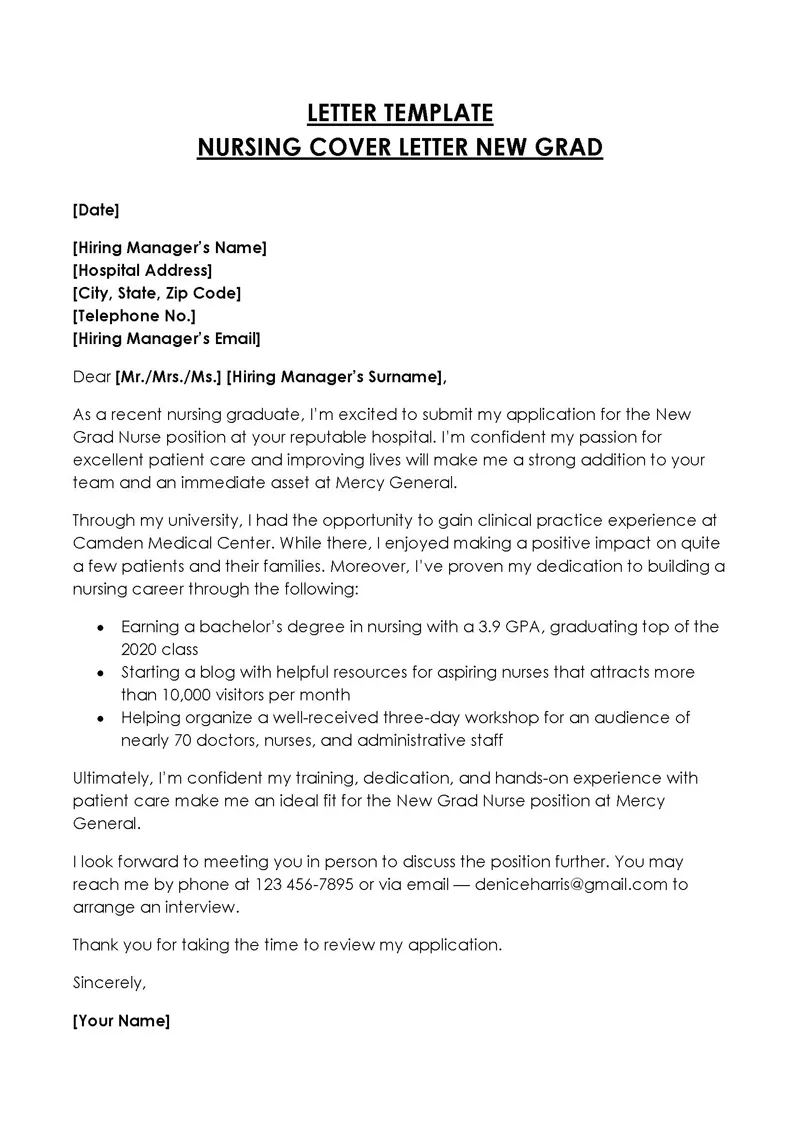
RN Cover Letter Key Components
A well-crafted RN cover letter is your first opportunity to make a strong impression on potential employers. It’s a crucial document that complements your resume, providing a more in-depth look at your qualifications, experience, and personality. Unlike a resume, which presents a concise summary of your skills and history, a cover letter allows you to elaborate on your accomplishments, explain your motivations, and demonstrate why you are the ideal candidate for the specific position. The key components of an effective RN cover letter include your contact information, a professional salutation, a compelling opening paragraph, a detailed explanation of your skills and experience, a demonstration of your passion for nursing, and a clear closing statement. By carefully constructing each of these elements, you can significantly increase your chances of securing an interview and landing your dream nursing job. Remember, tailoring your cover letter to each job application is essential to showcase your genuine interest and suitability for the role.
Contact Information & Salutation
Begin your cover letter by providing your contact information at the top. This should include your full name, address, phone number, and professional email address. Make sure the email address is professional and appropriate for a job application. Following your contact information, address the letter to the hiring manager or the specific person mentioned in the job posting. If you are unsure of the hiring manager’s name, do some research on the company’s website or LinkedIn. If you are unable to find a specific name, use a professional salutation such as ‘Dear Hiring Manager’ or ‘Dear [Department Name] Hiring Team.’ Avoid generic salutations like ‘To Whom It May Concern,’ as they can make your letter seem impersonal. Ensure the contact information is accurate and the salutation is personalized to demonstrate your attention to detail and respect for the potential employer.
Opening Paragraph Grab Their Attention

The opening paragraph of your RN cover letter is your chance to grab the reader’s attention and make a strong first impression. Start with a concise and compelling statement that immediately highlights your interest in the position and the organization. Briefly mention the specific role you are applying for and how you learned about it. If you were referred by someone, include their name to leverage the connection. You should also briefly mention your most relevant skill or accomplishment. The goal is to create immediate impact. Avoid generic opening lines that could apply to any job. Instead, tailor your introduction to the specific requirements of the position. For example, you could start with a statement like: ‘I am writing to express my enthusiastic interest in the Registered Nurse position at [Hospital Name], as advertised on [Platform].’ This opening immediately informs the reader of your intent and the source of the job posting. The opening paragraph should be a concise and engaging introduction that convinces the reader to continue reading.
Highlighting Your Nursing Skills & Experience
The main body of your cover letter is where you showcase your nursing skills and experience. Focus on the skills and experiences most relevant to the job description. Review the job posting carefully and identify the key requirements the employer is seeking. Then, provide specific examples of how your skills and experience align with those requirements. When describing your experience, use the STAR method (Situation, Task, Action, Result) to provide context and demonstrate your accomplishments. Briefly describe the situation, explain the task you were assigned, detail the actions you took, and highlight the positive results of your efforts. For example, if the job description emphasizes patient assessment skills, you could write: ‘In my previous role at [Hospital Name], I consistently performed comprehensive patient assessments. During one instance, I quickly identified a patient’s deteriorating condition. I immediately initiated necessary interventions, which resulted in a positive outcome.’ This approach helps illustrate your practical skills and their tangible impact. Quantify your achievements whenever possible. Instead of saying ‘Improved patient outcomes,’ state ‘Improved patient outcomes by 15% by implementing a new fall prevention protocol.’
Relevant Clinical Skills and Certifications
This section should specifically highlight your relevant clinical skills and any certifications you hold. Detail your experience with key nursing duties, such as administering medications, monitoring vital signs, and providing patient education. If the job description mentions specific skills, such as experience with electronic health records (EHRs) or specialized equipment, be sure to emphasize those skills. Also, include your certifications. For example, if you have a BLS (Basic Life Support) or ACLS (Advanced Cardiac Life Support) certification, mention this. If the role requires certifications such as a Critical Care Registered Nurse (CCRN), make sure you highlight that as well. Make sure to list the name of the certification, the issuing organization, and the date of certification. This demonstrates your commitment to professional development and your ability to meet the specific requirements of the role. Tailor this part of your letter to match the job description, making sure to only include the most pertinent and relevant skills and certifications.
Quantifiable Achievements in Nursing

In addition to listing your skills, quantify your achievements to demonstrate your impact. Use numbers and data to illustrate your accomplishments. Instead of saying you provided excellent patient care, specify how your care improved patient outcomes or satisfaction scores. For example, you could write: ‘Reduced patient readmission rates by 10% by implementing a new discharge planning program.’ If you’ve led a team, mention the size of the team and any improvements you achieved. If you have experience with quality improvement initiatives, quantify the results. If you implemented a new protocol that improved efficiency, include the percentage of time or cost savings. This makes your claims more credible and shows your value to the organization. Also, if you’ve received any awards or recognition for your performance, be sure to mention those as well, giving specific examples and the positive impact of your achievements.
Showcasing Your Passion and Fit
In this section, you should clearly articulate your passion for nursing and your enthusiasm for the specific role and organization. Explain what motivates you to be a nurse and what draws you to this particular healthcare setting. Demonstrate your understanding of the organization’s mission, values, and culture. Research the organization to understand its priorities, and tailor your letter to reflect how your values align with theirs. Mention any personal or professional experiences that have shaped your commitment to nursing. If you have a specific area of interest within nursing, such as critical care, pediatrics, or geriatrics, mention this, and explain why you are passionate about that specialty. This shows the hiring manager that you are not just looking for a job but are genuinely invested in the profession. Showcase how your career goals align with the organization’s goals, making you a valuable and motivated addition to the team. Furthermore, include any relevant volunteer experience or professional memberships.
Demonstrating Your Understanding of the Role and Organization
Show the hiring manager that you understand the role and the organization’s needs by demonstrating your research and preparation. Refer back to the job description and address the specific requirements and responsibilities. Explain how your skills and experience directly address these needs and how you can contribute to the organization’s success. Show that you have researched the organization’s mission, values, and recent achievements. Mention any specific initiatives, programs, or services that align with your interests and skills. Tailor your letter to reflect your understanding of the organization’s culture and its goals. Briefly discuss how you see yourself contributing to the team. Highlight your skills and experiences that make you a good fit for the role, for example, teamwork abilities, problem-solving skills, or any leadership experience. This shows that you have taken the time to understand the company’s needs and are prepared to contribute to its success, making your application more compelling.
Expressing Enthusiasm and Follow-Up

In your closing paragraph, express your enthusiasm for the opportunity and reiterate your interest in the position. Thank the hiring manager for their time and consideration. Include a call to action by stating your availability for an interview and how you can be reached. Clearly state that you look forward to hearing from them soon. Reiterate your excitement about the possibility of contributing to the organization’s mission. Keep the closing concise and professional, making sure to leave a lasting positive impression. Make sure that you include your contact information again, as a final confirmation. Ensure that you also include the best way to reach you, for example, your phone number or email address. Proofread your cover letter carefully for any errors in grammar, spelling, or punctuation before submitting it. This simple step can make a big difference.
Closing & Formalities
The closing of your RN cover letter should be professional and concise. Use a formal closing such as ‘Sincerely,’ ‘Respectfully,’ or ‘Best regards,’ followed by your full name. Leave space for your signature if you are submitting a hard copy; otherwise, your typed name is sufficient. Proofread your entire cover letter carefully to ensure it is free of errors. Check for grammatical errors, spelling mistakes, and punctuation errors. Ensure that your formatting is consistent and professional. It’s also important to tailor the letter to the specific job and the organization. Avoid using generic templates. Instead, customize your cover letter to reflect the requirements of the role and your genuine interest in the position. Always attach your resume to your cover letter and other required documents. By following these guidelines, you can create an effective RN cover letter that showcases your qualifications and increases your chances of landing an interview and securing your dream nursing job. Good luck with your job search!