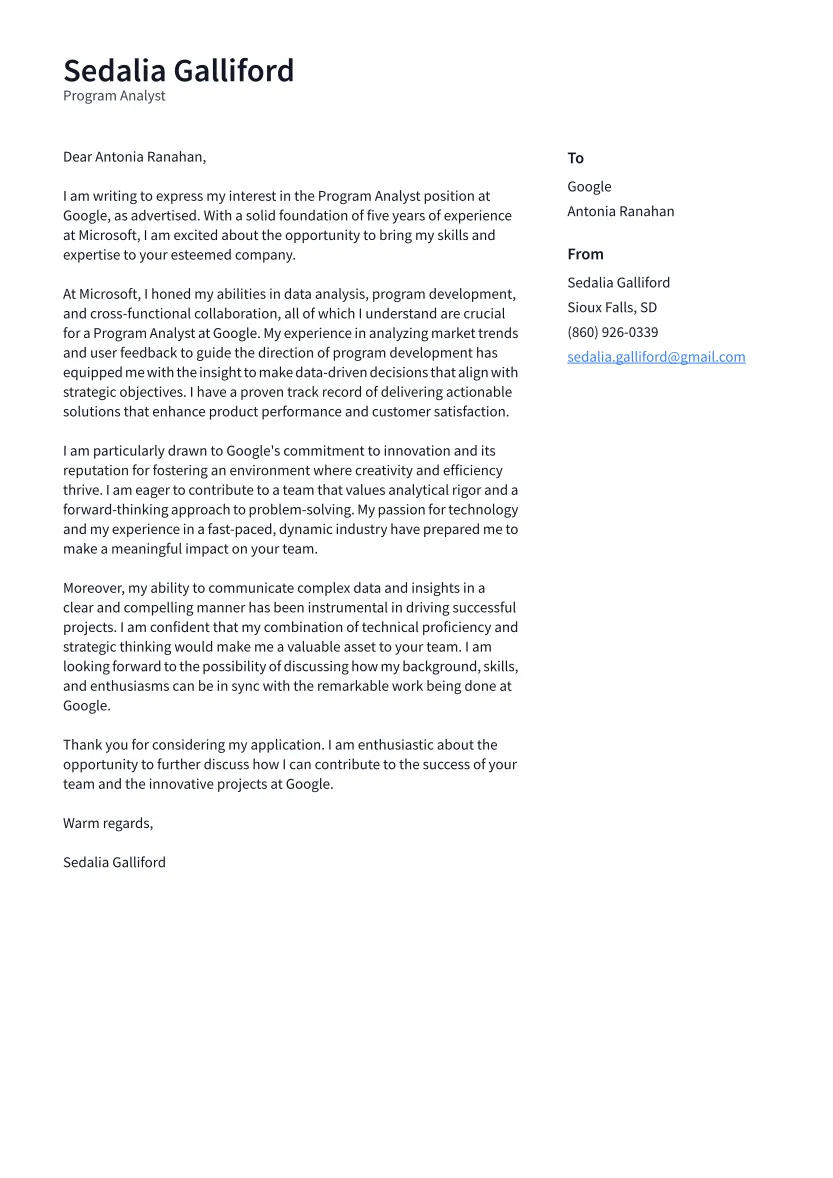
Understanding the Program Analyst Role
A Program Analyst is a crucial member of any organization, responsible for the effective planning, execution, and monitoring of programs. Their primary objective is to improve program efficiency, ensure alignment with organizational goals, and drive successful outcomes. This role requires a blend of analytical, communication, and organizational skills to manage projects from conception to completion. Program Analysts are pivotal in data analysis, performance reporting, and identifying areas for program improvement. Understanding the core functions of a Program Analyst is the first step to crafting a compelling cover letter that highlights your suitability for the role. Your cover letter needs to demonstrate not just that you understand the job, but that you also bring a specific value to the table, showcasing your ability to think strategically and deliver results. It’s an opportunity to convince the hiring manager that you understand the challenges they face and are prepared to meet them head-on.
Key Responsibilities of a Program Analyst
Program Analysts wear many hats, with responsibilities that can vary based on the organization and program in question. However, several key tasks are consistent across most roles. These include conducting program evaluations, developing program plans, managing budgets, and reporting on program progress. They often collaborate with various stakeholders, from senior management to individual team members, to ensure programs stay on track. Their analytical skills come into play when they assess data, identify trends, and provide recommendations for improvement. They also play a vital role in risk management, identifying potential challenges and implementing strategies to mitigate them. Essentially, they are the engines that keep programs running smoothly, efficiently, and aligned with strategic goals. Highlighting your relevant experience and achievements in these key areas is critical when writing your cover letter.
Essential Skills for Program Analysts

To excel as a Program Analyst, a specific set of skills are required. Strong analytical skills are crucial for interpreting data, identifying problems, and formulating solutions. Excellent communication and interpersonal skills are necessary for collaborating with stakeholders and presenting findings. Proficiency in project management methodologies like Agile or Waterfall is often expected, as is the ability to manage budgets and resources effectively. Program Analysts must also be adept at problem-solving, critical thinking, and decision-making. Additional skills such as proficiency in relevant software and tools, as well as experience in data visualization, can set you apart. When crafting your cover letter, be sure to highlight these skills and back them up with concrete examples from your professional background. Use the language from the job description to mirror the skills the employer is looking for.
Crafting Your Program Analyst Cover Letter
Your cover letter is your first opportunity to make a strong impression. It should showcase your skills, experience, and passion for the role, all while demonstrating that you’ve researched the company and understand the specific needs of the position. A well-written cover letter can significantly increase your chances of landing an interview. This section will take you through the essential components of a persuasive program analyst cover letter, from the opening paragraph to the closing call to action, ensuring that you make a positive and lasting impression. Remember, your cover letter isn’t just a summary of your resume; it’s a narrative that explains why you’re the ideal candidate and what makes you uniquely suited to the role.
Header and Contact Information
The header of your cover letter sets the tone for the rest of your document. Start by including your full name, address, phone number, and professional email address. This information should be clearly displayed at the top left or right of the document. Then, add the date, followed by the hiring manager’s name and title, and the company’s name and address. Research the hiring manager’s name; personalizing the cover letter shows you’ve put in the effort. Ensure your contact information is accurate and up-to-date. Your email address should be professional, and your phone number should be one where you can be easily reached. This section is about establishing the foundation of your application and making it easy for the hiring manager to contact you. It also demonstrates your attention to detail, a critical attribute for a Program Analyst.
The Opening Paragraph

The opening paragraph is your opportunity to grab the reader’s attention. Start with a strong, concise statement that immediately identifies the position you’re applying for and where you saw the job posting. If you were referred by someone, mention that here. Briefly highlight your most relevant qualifications and why you’re excited about the opportunity. Tailor this paragraph to show your understanding of the company and the role. Avoid generic opening lines; instead, show enthusiasm and demonstrate your knowledge of the company’s mission or recent achievements. This initial paragraph sets the stage, so it’s essential to make it compelling and relevant. Aim to capture the reader’s attention within the first few sentences, motivating them to continue reading and learn more about your qualifications.
Highlighting Your Skills and Experience
The main body of your cover letter should showcase your relevant skills and experiences. Select 2-3 key skills and provide specific examples of how you’ve used them in past roles. Instead of simply listing your responsibilities, describe your accomplishments and the impact you made. Use the STAR method (Situation, Task, Action, Result) to structure your examples. For instance, describe the situation you faced, the task you were assigned, the actions you took, and the positive results you achieved. This narrative approach makes your achievements more tangible and memorable. Align your skills with the requirements listed in the job description to demonstrate your suitability for the position. Focus on quantifiable achievements whenever possible to illustrate the value you would bring to the role. This section should provide concrete evidence of your capabilities.
Quantifying Achievements
Quantifying your achievements is critical in making a strong case for your candidacy. Instead of stating that you ‘improved program efficiency,’ specify by how much. For example, ‘Improved program efficiency by 15% within six months, resulting in cost savings of $50,000.’ Use numbers, percentages, and specific metrics to illustrate your accomplishments and the impact you made in previous roles. This provides concrete evidence of your capabilities and makes your claims more persuasive. Think about metrics such as cost savings, revenue generated, projects completed, or deadlines met. These quantifiable achievements are far more impactful than generic statements and will make your cover letter stand out from the competition. It shows the hiring manager that you’re not just claiming to be effective but that you have a proven track record of achieving results.
Tailoring to the Job Description

Tailoring your cover letter to the specific job description is a must. Review the job posting carefully and identify the key requirements, skills, and qualifications the employer is seeking. Then, align your skills and experiences with these requirements. Use the same keywords and phrases from the job description throughout your cover letter to demonstrate that you’re a good fit for the position. Research the company and learn about their mission, values, and recent projects. This shows that you are genuinely interested in the company and have taken the time to understand their needs. The more you tailor your cover letter, the better the chances of it resonating with the hiring manager. Personalization demonstrates to the employer that you’re not just sending a generic application; you’re genuinely interested in the role and the company.
Demonstrating Enthusiasm
Demonstrating your enthusiasm for the role is crucial. Show your excitement about the opportunity, the company, and the work you would be doing. Avoid generic statements and instead, express your genuine interest in the position. Explain why you’re interested in the company’s mission, what aspects of the role excite you, and how you envision contributing to the team. Research the company and find something specific that interests you, and mention it. This could be a particular project, a company value, or a recent achievement. Your enthusiasm should be evident throughout the cover letter, from the opening paragraph to the closing. This passion will help you stand out and leave a lasting impression on the hiring manager. Your excitement signals that you are not just seeking a job but that you are genuinely interested in the organization and the opportunity.
Structuring Your Cover Letter for Impact
The structure of your cover letter significantly impacts its effectiveness. A well-organized cover letter is easy to read and allows the hiring manager to quickly grasp your key qualifications and understand why you’re a good fit. This section will explore the key aspects of structuring your cover letter, including formatting, length, and the use of action verbs to make it more impactful. The ultimate goal is to create a document that is both informative and compelling, helping you to secure an interview and advance in the hiring process. A strong structure will make the document both readable and easy to digest.
Formatting and Length

Keep your cover letter concise and easy to read. Aim for a length of no more than one page. Use a professional font like Arial or Times New Roman, with a font size of 11 or 12 points. Use single spacing within paragraphs and double spacing between paragraphs. Maintain consistent formatting throughout the document. Use clear headings and bullet points to break up large blocks of text and make the content more digestible. Proper formatting demonstrates attention to detail and makes your cover letter more engaging. A well-formatted cover letter shows the hiring manager that you respect their time and value clarity. A clear format enables them to quickly grasp your key qualifications and understand your value proposition. Avoid lengthy paragraphs, and use bullet points whenever possible.
Using Action Verbs
Using strong action verbs is a key to making your cover letter more dynamic and impactful. Start your sentences with action verbs to highlight your accomplishments and responsibilities. Instead of saying ‘Responsible for project management,’ try ‘Managed projects from conception to completion, delivering them on time and under budget.’ Examples of effective action verbs include ’led,’ ‘managed,’ ‘developed,’ ‘implemented,’ ‘analyzed,’ ‘coordinated,’ ‘achieved,’ and ‘improved.’ Using action verbs creates a sense of energy and demonstrates your active role in past projects. It also helps the hiring manager quickly understand what you achieved in previous roles. Choose action verbs relevant to the job description to show the hiring manager how you’ve used your skills and experience effectively. Using dynamic verbs can transform your cover letter, making it more engaging and memorable.
Proofreading and Editing
Proofreading and editing your cover letter is a non-negotiable step in the application process. Errors in grammar, spelling, and punctuation can undermine your credibility and make you appear unprofessional. Carefully review your cover letter for any mistakes. Read it aloud to catch any awkward phrasing or typos. Have a friend, family member, or career advisor review your cover letter as well. A fresh pair of eyes can often spot errors that you might miss. Ensure all your information is accurate, including dates, titles, and contact details. This attention to detail demonstrates your commitment to quality and professionalism. A polished cover letter is a testament to your skills, highlighting your qualifications and making it more likely to secure the role. A well-edited and proofread cover letter reflects your professionalism and attention to detail.
Common Mistakes to Avoid

Avoid common mistakes to ensure your cover letter makes a positive impression. This section will explore some common pitfalls that can detract from your application and negatively affect your chances of getting an interview. By being aware of these errors, you can avoid them and ensure your cover letter highlights your qualifications effectively. Pay close attention to these aspects to increase your chance of success.
Generic Cover Letters
Avoid sending generic cover letters. Tailor each cover letter to the specific job and company. A generic letter suggests you haven’t taken the time to understand the role or the company’s needs. Always address the hiring manager by name. Mention specific aspects of the company or role that interest you. Demonstrate that you’ve researched the company’s mission, values, and recent achievements. The more personalized your cover letter, the more likely it is to stand out and capture the hiring manager’s attention. Tailoring the letter shows you have a genuine interest and haven’t just mass-submitted applications.
Typos and Grammatical Errors
Typos and grammatical errors can damage your credibility. They suggest a lack of attention to detail and professionalism. Carefully proofread your cover letter before sending it. Use spell check and grammar check, but don’t rely on them entirely. Read your cover letter aloud to catch awkward phrasing or errors. Have a friend or family member proofread it as well. A well-written cover letter is a reflection of your skills and attention to detail, highlighting that you care about the quality of your work. Ensuring that your letter is free of errors is a key step.
Failing to Showcase Relevant Skills

Failing to showcase relevant skills is a missed opportunity. Read the job description carefully and identify the skills and qualifications the employer is seeking. Make sure your cover letter highlights those skills. Provide specific examples of how you’ve used these skills in past roles, using the STAR method (Situation, Task, Action, Result) to structure your examples. Quantify your achievements whenever possible. Use keywords and phrases from the job description to demonstrate your suitability for the position. Your goal is to show the hiring manager that you have the skills they need to succeed in the role. Clearly demonstrating how your skills align with the job requirements is vital.
The Closing and Call to Action
The closing of your cover letter should reiterate your interest in the role and include a call to action. This section will guide you on the best practices for ending your cover letter. A strong closing will leave a lasting impression, motivating the hiring manager to invite you for an interview. Ensure your closing is professional and leaves a positive impression.
Expressing Gratitude
Express your gratitude for the hiring manager’s time and consideration. Thank them for reviewing your application and express your enthusiasm for the opportunity. Avoid generic phrases; instead, make your thanks specific and sincere. For example, you could say, “Thank you for considering my application. I am eager to learn more about this opportunity.” A sincere expression of gratitude leaves a positive impression and reflects well on you. By expressing your thanks, you show respect and appreciation for the hiring manager’s time. It’s a small gesture that can leave a lasting impression.
Providing Contact Information
Restate your contact information in the closing, making it easy for the hiring manager to reach you. Include your phone number and email address. If you have a professional online profile (like LinkedIn), you can also include the link. Ensure your contact information is accurate and up-to-date. Make it easy for the hiring manager to contact you quickly and conveniently. Provide this information so that they can easily reach out. It’s a reminder of how to reach you and shows your enthusiasm for the role.
Following Up
After submitting your cover letter and resume, consider following up. Send a brief email to the hiring manager a week or two after the application deadline to reiterate your interest. Thank them again for their consideration. Reference the specific role you applied for. Keep your follow-up email concise and professional. Following up demonstrates your initiative and continued interest. It’s a subtle way to remind the hiring manager of your application. This act can increase your chances of receiving a response, so be polite but persistent, allowing you to stand out.