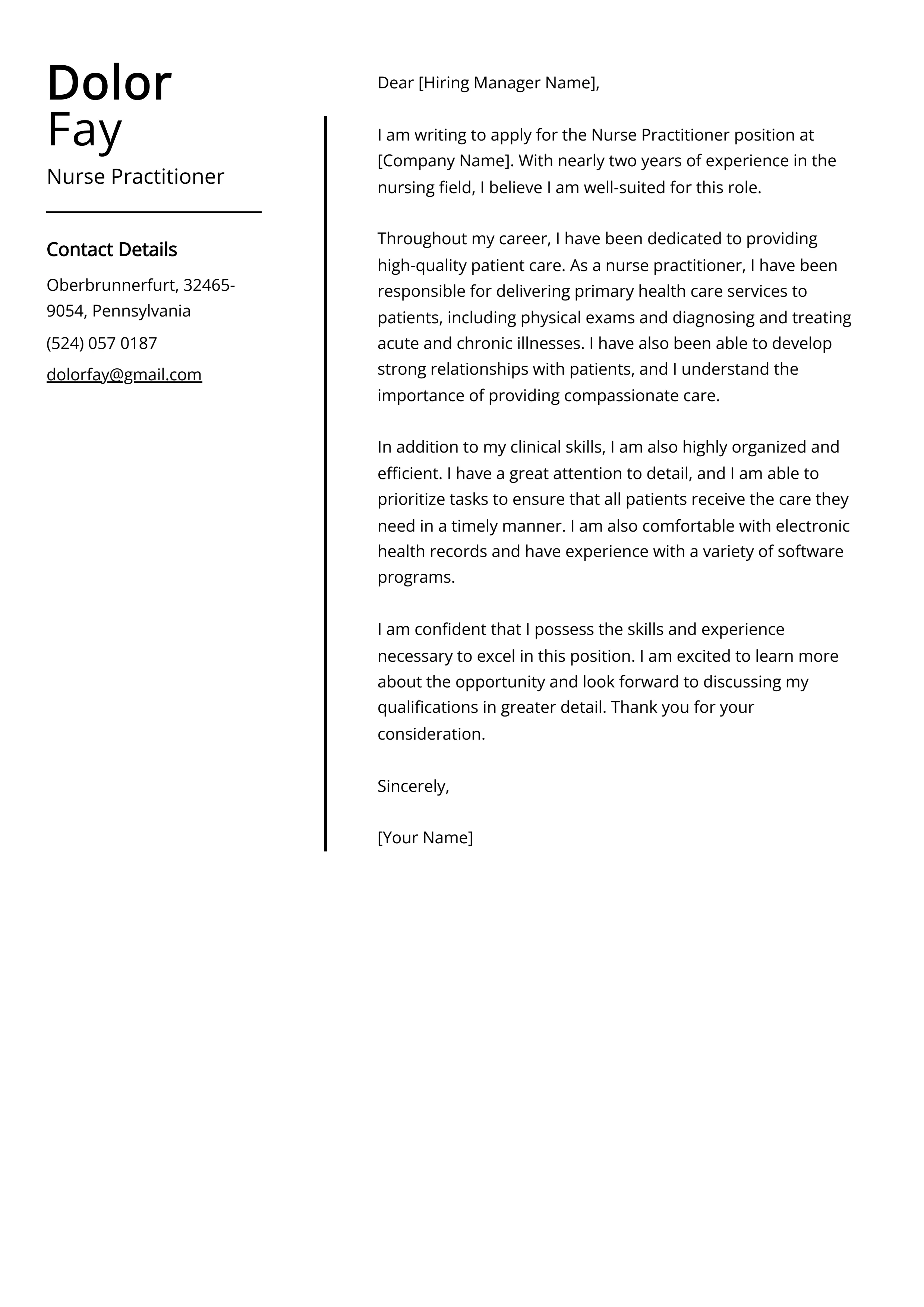
Crafting a Winning Nurse Practitioner Cover Letter
A well-crafted nurse practitioner cover letter is your first opportunity to make a strong impression on a potential employer. It serves as a vital introduction, showcasing your qualifications, skills, and enthusiasm for the position. Unlike your resume, which provides a comprehensive overview of your experience, the cover letter allows you to personalize your application and highlight the specific aspects of your background that align with the job requirements. Mastering the art of the cover letter can significantly increase your chances of landing an interview and ultimately securing your desired role in the healthcare field.
Understanding the Importance of a Cover Letter
The cover letter is far more than just a formality. It’s a crucial tool for setting yourself apart from other applicants. In a competitive job market, a compelling cover letter can be the deciding factor between your application being considered or overlooked. It demonstrates your communication skills, your understanding of the role, and your genuine interest in the organization. By using the cover letter effectively, you can highlight your key achievements, explain any career gaps, and express your passion for nursing and patient care, making you a more attractive candidate.
Highlighting Your Skills and Experience

Your cover letter should be a showcase of your abilities and experiences. Focus on the skills and experiences most relevant to the job description. This could include your clinical expertise, your ability to work collaboratively with other healthcare professionals, your experience with specific patient populations, or any leadership roles you have held. Use specific examples to illustrate your accomplishments. For instance, instead of stating ‘Managed patient care,’ describe how you ‘Managed a caseload of 30 patients daily, resulting in a 15% improvement in patient satisfaction scores.’
Key Components of a Nurse Practitioner Cover Letter
Contact Information and Salutation
Begin with your contact information, including your name, address, phone number, and email address. Follow this with the date and the recipient’s information (name, title, and organization). Use a professional salutation, such as ‘Dear Dr. [Last Name]’ or ‘Dear Hiring Manager.’ If you are unsure of the hiring manager’s name, research the organization’s website or LinkedIn. Avoid generic salutations like ‘To Whom It May Concern’, as it can make your letter feel impersonal. Pay close attention to the details here; ensuring accurate formatting is essential for portraying professionalism.
Opening Paragraph: Grabbing Their Attention

Your opening paragraph is your chance to make a strong first impression. State the position you are applying for and where you saw the job posting. Briefly highlight your most relevant qualifications and express your enthusiasm for the opportunity. Instead of starting with a generic statement, consider mentioning a specific achievement or a shared interest in the healthcare organization’s mission. This approach immediately captures the reader’s attention and motivates them to read further. The opening statement can also include a short summary about your unique qualities or skills.
Body Paragraphs: Showcasing Your Value
The body paragraphs are the core of your cover letter. Use these paragraphs to elaborate on your skills, experience, and accomplishments. Demonstrate how your qualifications align with the job requirements. Provide specific examples to support your claims and quantify your achievements whenever possible. Show, don’t just tell. This is where you demonstrate your value and convince the employer that you are the right fit for the role. Focus on how your skills and experience can benefit the organization and contribute to its goals.
Highlighting Relevant Skills and Experience
Select the skills and experiences that best match the job description. If the job requires experience in a specific area, emphasize your proficiency in that area. If the role emphasizes leadership, highlight any leadership positions you’ve held and the results you achieved. Tailor each cover letter to the specific job and organization. Ensure you address the key requirements outlined in the job description, demonstrating how you possess the necessary skills and experiences to excel in the role.
Quantifying Accomplishments and Results

Whenever possible, quantify your accomplishments. Use numbers and data to illustrate your impact. For example, instead of saying ‘Improved patient outcomes,’ state ‘Improved patient outcomes by 20% through implementing evidence-based practices.’ This makes your claims more credible and demonstrates your ability to deliver results. Metrics help employers understand the value you bring to the table. Consider including numbers in your cover letter where it can make the greatest impact and provide a clear demonstration of your competencies.
Closing the Letter
The closing paragraph is your opportunity to express your enthusiasm and call to action. Reiterate your interest in the position and the organization. Thank the employer for their time and consideration. State your availability for an interview and provide your contact information again. Keep the closing concise and professional. Avoid overly casual language or demands. A confident and proactive closing reinforces your interest and sets the stage for the next step in the hiring process.
Expressing Enthusiasm and Seeking an Interview
Reiterate your enthusiasm for the position and the organization. Express your desire to discuss your qualifications further. Clearly state your availability for an interview and provide your contact information. Make it easy for the employer to take the next step. This reinforces your interest and demonstrates your proactive approach to the application. Emphasize that you’re looking forward to speaking with them at their convenience.
Proofreading and Formatting

Before submitting your cover letter, meticulously proofread it for any grammatical errors, spelling mistakes, and typos. Ensure the formatting is consistent and professional. A well-formatted and error-free cover letter demonstrates your attention to detail and commitment to quality. Poorly written or formatted letters can create a negative impression and undermine your application. Take the time to ensure your cover letter presents you in the best possible light.
Formatting Guidelines
Use a professional and easy-to-read font, such as Times New Roman, Arial, or Calibri, in a size between 10 and 12 points. Use single spacing within paragraphs and double spacing between paragraphs. Align your text to the left and avoid using excessive bolding or underlining. Ensure that your margins are consistent and that your letter is visually appealing. Make sure the overall presentation is neat and professional, making the letter simple to read.
Proofreading Tips
Proofread your cover letter multiple times. Check for spelling errors, grammatical mistakes, and punctuation errors. Read your letter aloud to catch any awkward phrasing or sentences. Consider having a friend or family member review your letter for a fresh perspective. Use spell-check and grammar-check tools, but don’t rely on them entirely. Thorough proofreading is critical for ensuring your cover letter makes a positive impression.
Tailoring Your Cover Letter

Customize your cover letter for each position you apply for. Generic cover letters are easily identified and can undermine your application. Tailor your letter to the specific job description and the organization’s values and mission. This shows the employer that you have taken the time to understand their needs and that you are genuinely interested in the position. Customized cover letters demonstrate your attention to detail and that you have a genuine interest in the specific opportunity.
Researching the Healthcare Organization
Before writing your cover letter, research the healthcare organization. Visit their website, read their mission statement, and review their recent news and publications. This will help you understand their values, goals, and culture. Use this information to tailor your cover letter and demonstrate how your skills and experience align with their needs. This shows that you have a genuine interest in working for the organization and that you have the research to prove it.
Customizing Your Letter for Each Position
Carefully review the job description and identify the key requirements. Highlight the skills and experiences most relevant to the position. Use the same keywords and phrases from the job description in your cover letter. This ensures that your letter aligns with the employer’s expectations. Tailor your cover letter to reflect the specific needs of each position and showcase why you are the ideal candidate for the role.
Examples of Nurse Practitioner Cover Letter

Example 1 Focused on Clinical Expertise
This example showcases a candidate’s expertise in a specific clinical area, such as cardiology or dermatology. The cover letter highlights their experience treating specific patient populations and their knowledge of relevant medical procedures and technologies. The focus is on their ability to provide high-quality patient care and their commitment to patient safety. These nurses are highly valuable, and the focus is on the quality of the care given. Make sure to tailor your cover letter to these types of roles.
Example 2 Emphasizing Leadership Skills
This example emphasizes a candidate’s leadership abilities. The cover letter highlights experiences in supervising, mentoring, or leading teams. It showcases their ability to manage projects, make decisions, and drive improvements in patient care. This type of cover letter is suitable for positions that require leadership, such as a nurse practitioner who will lead a team or manage other providers. Leadership qualities can boost your prospects considerably.
Example 3 Highlighting a Specialization
This example highlights a specialized area of practice, such as geriatrics, pediatrics, or women’s health. The cover letter emphasizes the candidate’s specialized knowledge, skills, and experience in that particular field. It showcases their passion for the specialty and their commitment to providing specialized care to patients. If you have a certification in a specific area, be sure to show it off in your cover letter. This is a great way to impress the hiring manager.