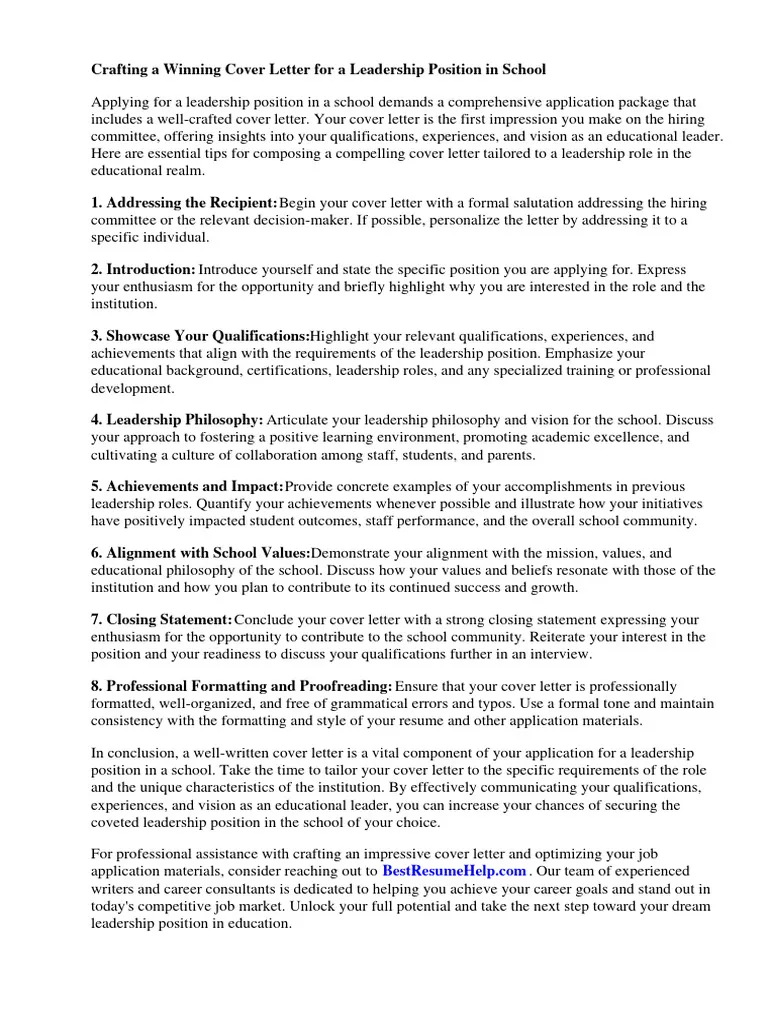
Crafting a Leadership Cover Letter
A leadership cover letter is your first impression, a chance to showcase your leadership qualities and secure that coveted position. Unlike a standard cover letter, this document is designed to highlight your experience, skills, and accomplishments in a way that resonates with leadership roles. It’s about more than just listing your past roles; it’s about demonstrating your ability to lead, inspire, and drive results. A well-crafted leadership cover letter grabs attention by immediately showing your understanding of the company’s needs and how you can contribute to their success. Therefore, approaching your cover letter with a strategic mindset is key.
Understanding the Purpose of a Leadership Cover Letter
The primary goal of a leadership cover letter is to convince the hiring manager that you are the best candidate for the leadership role. It’s not just a formality; it’s an opportunity to differentiate yourself from other applicants. Your letter should articulate your leadership philosophy, vision, and how you can contribute to the company’s goals. It should answer the question: ‘Why should we choose you to lead?’ It needs to be a persuasive argument showcasing your unique value proposition. This includes how you plan to lead a team, what strategies you’ve used in the past, and what outcomes you achieved. It must also align with the company’s mission and values, demonstrating that you’re a cultural fit.
Highlighting Leadership Skills and Experience

When highlighting your skills and experience, focus on leadership-specific competencies such as strategic thinking, decision-making, team building, and conflict resolution. Provide concrete examples of how you have demonstrated these skills in past roles. For instance, instead of saying ‘managed a team,’ describe how you ’led a team of 15 employees, resulting in a 20% increase in productivity and a 15% reduction in employee turnover.’ Use action verbs to emphasize your accomplishments and the impact you’ve made. Tailor your examples to match the requirements outlined in the job description, ensuring you address the specific needs of the role.
Leadership Cover Letter Structure
A well-structured cover letter is easier to read and more likely to capture the reader’s attention. Start with a strong opening paragraph that immediately grabs the reader’s interest. Follow with a concise summary of your relevant experience and skills, highlighting your key achievements. Use bullet points to break up large blocks of text and make your letter more scannable. This makes the letter more digestible and easier for the hiring manager to quickly grasp your qualifications. Conclude with a call to action, expressing your enthusiasm for the role and your availability for an interview.
The Opening Paragraph
The opening paragraph is your first and often only chance to make a strong impression. It should immediately grab the reader’s attention and clearly state the position you are applying for and where you found the job listing. Begin by expressing your enthusiasm for the role and the company. Briefly mention something that attracted you to the position, such as the company’s mission or a specific project. Consider starting with a strong statement that reflects your leadership philosophy. For example, ‘As a proven leader with a passion for [industry], I am excited to apply for the [position] position at [company].’ Show them why you’re the best candidate and what they’ll gain by hiring you.
Key Elements to Include

Your leadership cover letter should include the following key elements: a clear statement of the position you are applying for, a brief overview of your relevant experience and skills, specific examples of your leadership achievements, and a demonstration of your understanding of the company’s needs and how you can contribute. Address the specific requirements outlined in the job description and show how your skills align. This shows you’ve done your homework and are a good fit. Don’t forget to mention any awards, recognitions, or positive outcomes you’ve achieved that reflect your abilities.
Quantifiable Achievements
Quantifiable achievements are essential in a leadership cover letter. Instead of just stating that you “improved team performance,” provide specific metrics such as “increased team productivity by 30% within six months.” Use numbers to showcase your impact and demonstrate the value you brought to previous roles. These figures help to prove your claims and make your letter more compelling. Include percentages, dollar amounts, or any other quantifiable results that highlight your success. By including specific numbers, you make your accomplishments much more impactful and memorable, showing hiring managers what you can achieve.
Tailoring Your Cover Letter
Tailoring your leadership cover letter to each specific role and company is crucial. Research the company thoroughly, understand its values, and tailor your letter to reflect their specific needs and goals. Mention specific projects or initiatives you admire and explain how your skills and experience align with their objectives. Customize your cover letter by using keywords from the job description and highlighting the aspects of your experience that are most relevant to the role. Don’t send a generic cover letter; demonstrate your genuine interest and understanding of the company’s culture and requirements.
Matching Skills to Job Requirements

Carefully review the job description and match your skills and experience to the specific requirements listed. Highlight your relevant skills using the same language the employer uses in the description. If the job posting emphasizes strategic planning, make sure to highlight your experience in developing and implementing strategic plans, providing concrete examples of successful outcomes. If the job requires team leadership, showcase your skills in building and motivating teams, resolving conflicts, and fostering a positive work environment. Use the job description as your guide to tailoring the content and demonstrating your suitability.
Leadership Cover Letter Formatting
Proper formatting is important in creating a professional and readable cover letter. Use a clean, easy-to-read font such as Arial or Times New Roman in a size between 11 and 12 points. Maintain consistent formatting throughout the document. Use clear headings and bullet points to break up text and make the letter scannable. Keep the tone professional and concise, avoiding jargon and complex sentence structures. Ensure the layout is visually appealing and free of clutter. Use headings to organize sections, making it easy for the hiring manager to quickly find the information they need.
Choosing the Right Tone
The tone of your leadership cover letter should be professional, confident, and enthusiastic. Avoid sounding arrogant or overly casual. Convey your genuine interest in the role and the company. Use a positive and assertive tone, emphasizing your skills and achievements. Use language that reflects your leadership abilities. While expressing confidence, ensure your tone remains respectful and appropriate for the business setting. Aim for a tone that strikes a balance between professional and approachable, showing both competence and personality.
Proofreading and Editing

Proofreading and editing are essential steps in ensuring your cover letter is polished and error-free. Carefully review your cover letter for any grammatical errors, typos, or formatting inconsistencies. Ask a friend or colleague to review your letter as well, as a fresh pair of eyes can often catch mistakes you may have missed. Check for clarity, conciseness, and correct word choice. Make sure your cover letter flows logically and that your message is clear. A well-proofread cover letter demonstrates your attention to detail and professionalism, significantly increasing your chances of a positive response.
Leadership Cover Letter Best Practices
- Address the hiring manager by name whenever possible
- Customize your cover letter for each role
- Focus on your leadership skills and accomplishments
- Use action verbs to describe your achievements
- Quantify your achievements with numbers and data
- Keep it concise, ideally one page
- Proofread and edit carefully
Call to Action
Conclude your leadership cover letter with a strong call to action. Express your enthusiasm for the role and reiterate your interest in the company. Clearly state your availability for an interview. Thank the hiring manager for their time and consideration. Include your contact information so they can easily reach you. Make sure to proofread the entire letter before submitting, ensuring it is free of errors and leaves a positive impression. A well-crafted call to action encourages the hiring manager to take the next step and move you forward in the hiring process.