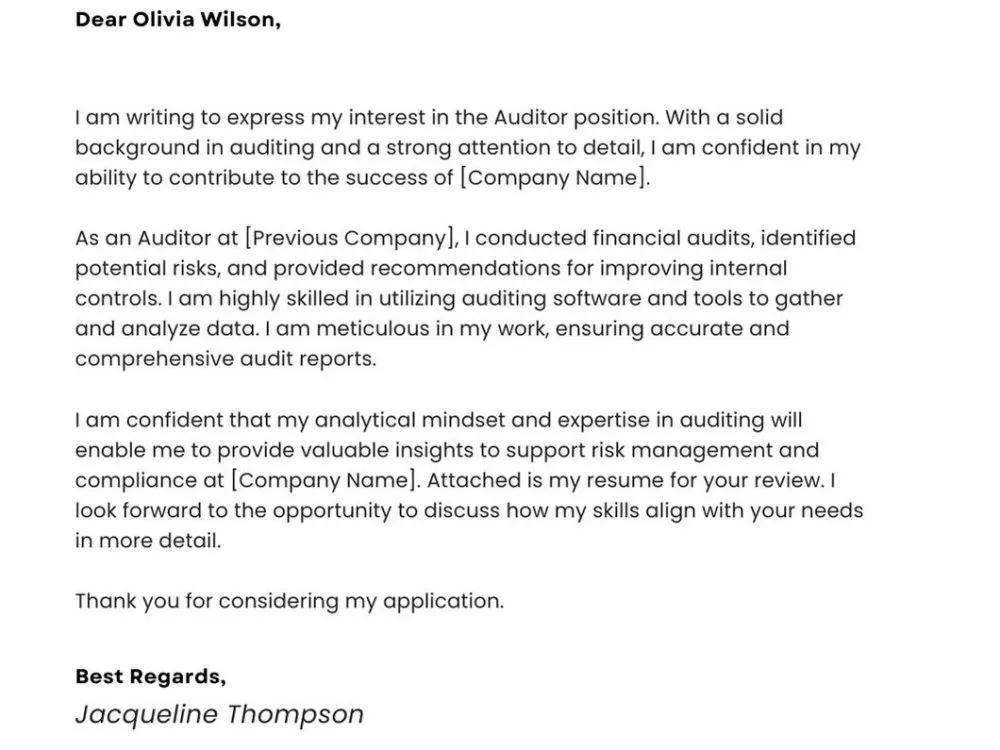
Understanding the Purpose of an Auditor Cover Letter
An auditor cover letter is more than just a formality it’s your initial introduction to a potential employer. It serves as a crucial tool in showcasing your qualifications, demonstrating your personality, and expressing your genuine interest in the role. Unlike your resume, which offers a concise overview of your experience, your cover letter provides an opportunity to elaborate on your skills, highlight specific achievements, and explain why you’re the ideal candidate for the auditing position. It’s your chance to create a compelling narrative that sets you apart from other applicants and persuades the hiring manager to delve deeper into your qualifications. Think of it as your personalized sales pitch, designed to secure an interview and ultimately land your dream job.
Key Components of an Effective Auditor Cover Letter
A well-structured auditor cover letter follows a clear and concise format, ensuring that the hiring manager can quickly grasp your key qualifications and interest in the role. Each section plays a vital role in conveying your professionalism and suitability for the position. From the essential contact information to the enthusiastic closing, every element should be crafted with precision and purpose. By adhering to a proven structure, you can effectively communicate your value and increase your chances of making a positive impression on the hiring team. Mastering the key components ensures that you present a polished and persuasive application package.
Contact Information and Date

Begin your cover letter with your complete contact information at the top left. This includes your name, address, phone number, and professional email address. Below this, on the same line or slightly below, include the date. This section is straightforward but essential. Accuracy here establishes a professional foundation for your application, ensuring the recruiter can easily reach you.
Hiring Manager’s Information
Direct your cover letter to a specific person whenever possible. Research the company’s website or use LinkedIn to find the hiring manager’s name or the recruiter’s name. Address the letter to this individual. If you can’t find a specific name, use a professional salutation like “Dear Hiring Manager.” This personalized touch shows you’ve done your homework and are genuinely interested in the opportunity.
Professional Greeting
Start with a formal greeting such as “Dear Mr/Ms. [Last Name]” or “Dear Hiring Manager,” as mentioned above if a name is unavailable. This sets a professional tone from the beginning of your cover letter. Avoid casual greetings like “Hi” or “Hello.” The greeting is the first interaction with the reader, and setting a professional tone is essential for making a positive first impression. The choice of greeting is very critical to the tone of the rest of the letter.
Opening Paragraph

The opening paragraph should immediately capture the reader’s attention. State the specific position you are applying for and briefly mention where you found the job posting. Then, summarize your key qualifications and express your interest in the company. A concise and compelling opening sets the stage for the rest of your cover letter. It should pique the hiring manager’s interest, encouraging them to keep reading. Focus on your enthusiasm and how your skills align with the company’s needs.
Highlighting Relevant Skills and Experience
The main body of your cover letter should showcase your skills and experience, aligning them with the job requirements. Provide specific examples of how you have used your skills in past roles to achieve results. Use the job description as a guide to determine which skills are most important to highlight. Your cover letter provides an opportunity to expand on the bullet points in your resume. Make your achievements clear, concise, and impactful, demonstrating a strong match between your qualifications and the open position. This section is your chance to prove your value.
Quantifying Achievements
Instead of simply listing your responsibilities, quantify your achievements whenever possible. Use numbers, percentages, and specific metrics to demonstrate your impact in previous roles. For example, instead of writing “Managed audits,” write “Managed audits for over 50 clients, resulting in a 15% reduction in audit errors.” This approach provides concrete evidence of your capabilities and makes your accomplishments more impressive. This approach helps demonstrate the value that you bring to a new employer.
Showcasing Technical Skills

Auditing roles require a range of technical skills. In your cover letter, highlight your proficiency with relevant software and tools, such as data analysis software (e.g., ACL, IDEA), accounting software (e.g., SAP, Oracle), and other relevant technologies. Provide specific examples of how you have used these skills in previous roles. If the job description emphasizes specific software or skills, make sure to mention them prominently. Be sure to tailor this to the specific requirements.
Demonstrating Soft Skills
While technical skills are important, don’t overlook soft skills. Auditors need strong communication, problem-solving, analytical, and organizational skills. Provide examples of how you have used these skills in your previous roles to successfully complete projects or resolve issues. Mention teamwork, time management, and the ability to work independently. Demonstrating these capabilities is crucial to portraying yourself as a well-rounded professional. Use real-life examples to highlight these skills.
Expressing Enthusiasm and Interest
Throughout your cover letter, express your genuine enthusiasm for the position and the company. Explain why you are interested in the role and what attracts you to the organization. This could include the company’s values, its industry, or the specific work you would be doing. Demonstrating your passion for the opportunity will make your application more memorable. Research the company to tailor your message and show you have a genuine interest in joining the team.
Concluding the Cover Letter

The conclusion of your cover letter should be concise and impactful. Summarize your key qualifications and reiterate your interest in the position. Thank the hiring manager for their time and consideration. Conclude with a strong call to action, such as inviting them to contact you for an interview or review your resume. A well-crafted conclusion reinforces your value and encourages the hiring manager to take the next step.
Call to Action
End your cover letter with a clear call to action. Indicate your availability for an interview and provide your contact information again if needed. A strong call to action encourages the hiring manager to take the next step in the hiring process. For example, state that you are eager to discuss your qualifications in more detail and are available for an interview at their earliest convenience. Making it easy for them to move forward is critical.
Proper Formatting and Proofreading
Proper formatting and proofreading are critical for creating a professional impression. Ensure your cover letter is well-organized, easy to read, and free of errors. A polished cover letter demonstrates attention to detail and professionalism, increasing your chances of making a positive impression on the hiring manager. Proofreading is a must. Sloppy errors will likely send the resume straight into the trash.
Formatting Tips

Use a professional font such as Times New Roman, Arial, or Calibri in a readable size (e.g., 11 or 12 points). Use single spacing with a space between paragraphs. Use clear headings and bullet points to break up large blocks of text and make your letter easy to scan. Keep the letter concise, ideally within one page. Proper formatting makes your cover letter visually appealing, organized, and easy to read, which is the first step to creating a favorable impression.
Proofreading Checklist
Before submitting your cover letter, carefully proofread it for any errors in grammar, spelling, and punctuation. Read it aloud to catch any awkward phrasing or sentences. Ask a friend or family member to review it for you. Check that your contact information is correct. Ensure the letter is tailored to the specific job and company. Proofreading ensures that your cover letter is polished and professional. Pay close attention to every detail. The smallest error can damage the impression.