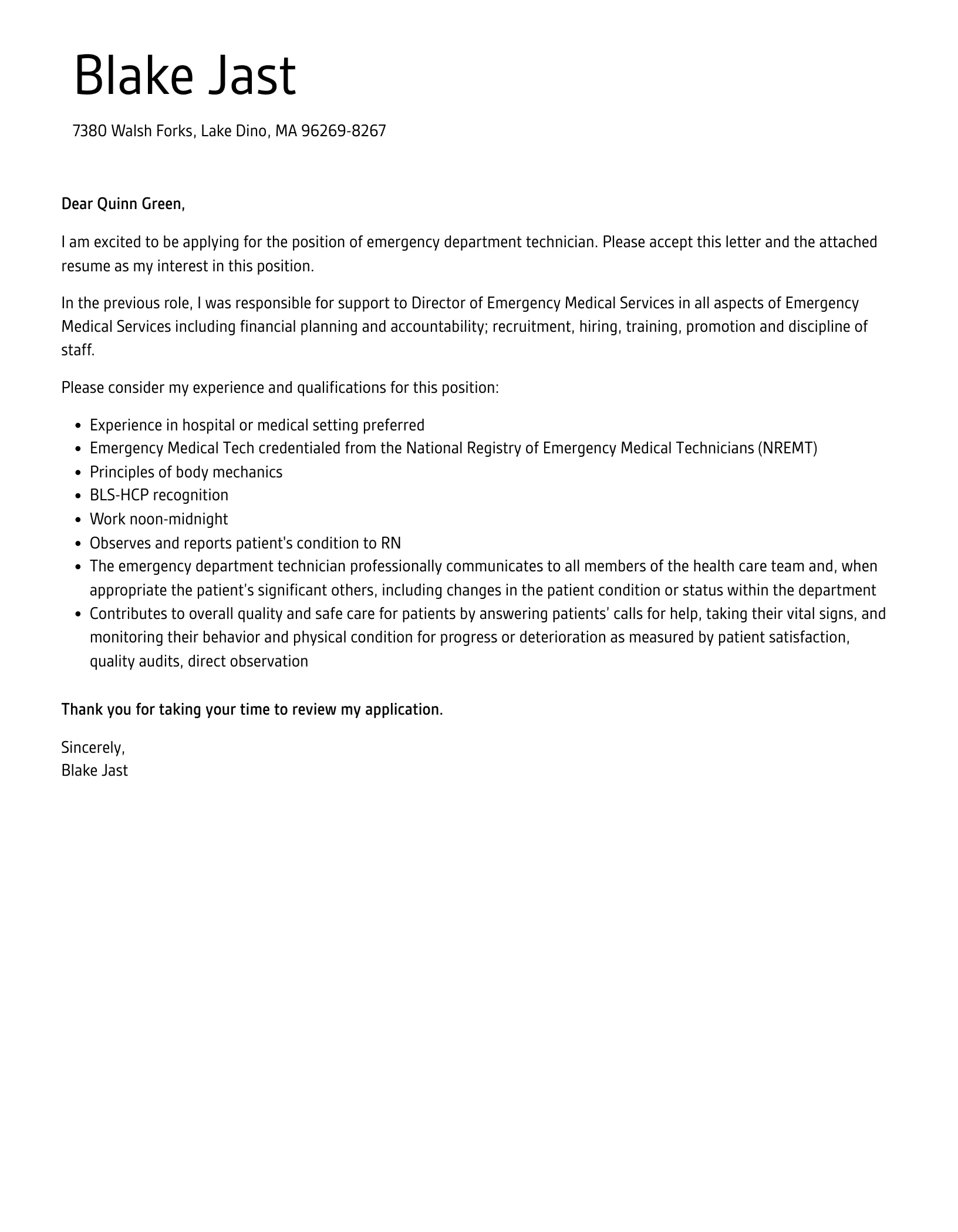
Understanding the Importance of an ER Tech Cover Letter
A well-crafted cover letter is your first impression on a potential employer. For an Emergency Room Technician (ER Tech), it’s more than just a formality; it’s your chance to showcase your skills, experience, and passion for the role. In the fast-paced environment of an ER, every detail matters. Your cover letter should reflect this urgency by highlighting your qualifications concisely and effectively. It provides context to your resume, allowing you to expand on your achievements and demonstrate how you align with the specific needs of the hospital or clinic. A strong cover letter can be the deciding factor in securing an interview, distinguishing you from other applicants and demonstrating your proactive approach to the job search. It allows you to personalize your application and show that you’ve taken the time to understand the position and the organization.
Key Components of a Strong ER Tech Cover Letter
A compelling ER Tech cover letter is built on several key components, each playing a crucial role in presenting you as a qualified candidate. These components work together to create a cohesive narrative that highlights your skills, experiences, and enthusiasm for the role. By carefully structuring your cover letter, you can ensure it captures the hiring manager’s attention and increases your chances of landing an interview. Remember to tailor each section to the specific requirements of the job description and the values of the healthcare facility to which you are applying. Attention to detail, clarity, and professionalism are paramount, as these qualities reflect the core responsibilities of an ER Technician.
Contact Information and Date

Start your cover letter by including your full name, address, phone number, and email address at the top. This information should be easily accessible and clearly visible. Directly beneath your contact information, add the date. This establishes the recency of your application and demonstrates your attention to detail. Ensure all the contact information is accurate. The date should reflect when you are sending the cover letter and should be formatted correctly.
Greeting the Hiring Manager
Addressing the hiring manager or the specific person listed in the job description is crucial. If possible, research the hiring manager’s name; a personalized greeting shows that you’ve taken the time to prepare. If you are unsure, use a professional greeting like “Dear Hiring Manager” or “Dear [Department Name] Hiring Team.” Avoid generic greetings such as “To Whom It May Concern.” This personal touch makes your application more engaging and professional.
Opening Paragraph Strategies
The opening paragraph sets the tone for your entire cover letter, so make it engaging and informative. Clearly state the position you are applying for and where you saw the job posting. Briefly mention how your skills and experience align with the role. You can also include a brief statement about your passion for the field or the specific facility. This is your chance to grab the reader’s attention from the start, signaling your enthusiasm and providing a concise summary of your qualifications. Keep it concise and focused on making a positive first impression.
Highlighting Your Skills and Qualifications

This section is the core of your cover letter. Focus on showcasing the skills and qualifications that make you an ideal ER Tech candidate. Provide concrete examples of your experience and how you’ve applied your skills in previous roles. This is where you demonstrate your competence in the essential duties of an ER Tech, such as patient care, technical procedures, and communication. Use specific examples to illustrate your abilities, backing up your claims with quantifiable achievements whenever possible. This section is crucial to setting you apart from other applicants. Consider organizing your skills into logical categories to enhance readability.
Technical Skills
Emphasize your technical skills, such as proficiency in taking vital signs (blood pressure, pulse, temperature, respiration rate), performing EKGs, and assisting with basic medical procedures. Detail any experience with specific equipment or software used in the ER environment. Mention certifications you hold, such as CPR, First Aid, and any relevant medical certifications like EMT or CNA. Quantify your experience whenever possible. For example, “Successfully performed EKGs on an average of 15 patients per shift.” Highlight your ability to follow protocols accurately and your understanding of medical terminology. Showcase any experience related to phlebotomy, splinting, or wound care.
Patient Care Skills
Detail your ability to provide compassionate and attentive patient care. Include examples of how you interact with patients, manage their comfort, and assist with their needs. Highlight your skill in observing and reporting patient conditions to nurses and physicians. Describe your experience in preparing patients for examinations and treatments, assisting with mobility, and ensuring their safety. Emphasize your ability to work calmly and efficiently under pressure. Mention any experience you have with electronic health records (EHRs) and your ability to maintain patient confidentiality.
Communication and Teamwork

ER Techs must possess excellent communication and teamwork skills. Describe your experience in effectively communicating with patients, families, nurses, physicians, and other healthcare professionals. Provide examples of how you’ve worked collaboratively in a team environment to achieve positive patient outcomes. Highlight your ability to listen actively, follow instructions, and share important information accurately. Mention your experience with resolving conflicts or handling challenging situations. Emphasize your understanding of the importance of clear and concise communication in an emergency setting.
Quantifying Your Achievements
Whenever possible, quantify your accomplishments. Instead of stating “Managed patient flow,” say, “Improved patient flow by 15% through efficient organization and triage.” Use numbers, percentages, and specific data to showcase your impact. For instance, you could state, “Reduced patient wait times by an average of 20 minutes.” Quantifying your achievements provides tangible evidence of your abilities. It shows the hiring manager that you are results-oriented and can make a positive difference in the workplace. This gives concrete evidence of your skills and makes your application more compelling.
Demonstrating Your Passion for the Role
Your cover letter should convey your genuine enthusiasm for the ER Tech role and the healthcare facility. This can significantly impact your application. Demonstrating your passion sets you apart from candidates. It showcases your commitment to patient care and your dedication to working in a fast-paced environment. This section allows you to express your professional drive and personal connection to the healthcare field.
Expressing Your Enthusiasm

Express your enthusiasm for the ER Tech role by explaining what motivates you. Share why you are drawn to the challenges and rewards of working in an emergency room. Discuss your commitment to providing exceptional patient care and your eagerness to learn and grow within the healthcare setting. You can also highlight specific aspects of the job that excite you, such as the opportunity to work with a diverse team, use advanced medical technologies, or help patients in critical situations. Showing your passion goes beyond just stating your interest. It helps build a personal connection with the hiring manager.
Researching the Hospital/Clinic
Demonstrate your interest in the specific hospital or clinic by researching its mission, values, and recent accomplishments. Mention any specific programs or initiatives that align with your own career goals and values. If you can, show how your skills and experiences align with the facility’s focus. Refer to the hospital’s website, social media profiles, and news articles to gather information. This shows you are not just applying for any job, but that you are genuinely interested in being part of that particular organization. Research helps you tailor your cover letter to the specific needs and values of the employer.
Closing the Cover Letter
The closing of your cover letter is your final opportunity to leave a positive impression. It should reinforce your interest in the position and provide a clear call to action. The tone should be professional and confident, reflecting your skills and enthusiasm. This section can strengthen your overall application. Make sure it is polished and error-free. A strong closing is your last chance to influence the hiring manager, so make it count.
Call to Action

Include a clear call to action. Express your interest in an interview and state how you can be reached. Provide your phone number and email address again for easy contact. Thank the hiring manager for their time and consideration. Express your excitement about the opportunity to discuss your qualifications further. A well-defined call to action encourages the hiring manager to move forward with your application. Make it easy for them to take the next step.
Professional Closing and Signature
Use a professional closing such as “Sincerely,” “Best regards,” or “Respectfully.” Type your full name and leave space for your signature above it if you plan to print and sign the letter. Make sure your signature is legible. Double-check that your contact information is accurate. Proofread the entire cover letter for any errors in grammar, spelling, and punctuation. A professional closing reflects your attention to detail and respect for the hiring manager. It reinforces your professionalism.