What is a Database Cover Letter
A database cover letter is a crucial document that accompanies your resume when applying for database-related positions. It serves as your first introduction to a potential employer, providing a concise overview of your qualifications, skills, and experience. Unlike a resume, which lists your credentials, a cover letter allows you to articulate your value proposition and explain why you are the ideal candidate for the role. It’s your opportunity to showcase your personality, enthusiasm, and understanding of the company’s needs. A well-crafted database cover letter can significantly increase your chances of securing an interview.
Why is a Database Cover Letter Important
In the competitive job market, a database cover letter offers several advantages. First, it allows you to tailor your application to the specific job requirements. You can highlight the skills and experiences most relevant to the position, demonstrating your understanding of the role and the company’s needs. Second, a cover letter provides an opportunity to elaborate on your resume entries. You can expand on your accomplishments, explain your contributions, and provide context that isn’t always possible in a resume format. Third, a cover letter showcases your communication skills and professionalism. It demonstrates your ability to write clearly, concisely, and persuasively, which is essential in any database-related role. Finally, a well-written cover letter sets you apart from other applicants and increases your chances of getting noticed by the hiring manager.
Key Components of a Database Cover Letter

A strong database cover letter typically includes several key components. These components work together to present a compelling case for your candidacy. Each section plays a specific role in conveying your qualifications and enthusiasm for the position. By understanding the purpose of each component, you can create a cover letter that effectively highlights your strengths and increases your chances of landing an interview. The main parts are header, opening, body, and the closing remarks.
Header and Contact Information
Begin your database cover letter with a professional header that includes your contact information. This ensures that the hiring manager can easily reach you. Your header should include your full name, address, phone number, and email address. Consider using a professional email address that includes your name. Also, include the date and the employer’s contact information, such as the name of the hiring manager (if known), their title, and the company’s address. Proper formatting makes a good first impression. See image “database-cover-letter-header” for a great example.
Salutation and Opening
Use a formal salutation, such as “Dear Mr./Ms./Mx. [Last Name],” if you know the hiring manager’s name. Researching the hiring manager’s name demonstrates your attention to detail. If you are unable to find the name, use a general greeting like “Dear Hiring Manager.” The opening paragraph should immediately grab the reader’s attention. State the position you are applying for and where you found the job posting. Briefly explain why you are interested in the role and the company. Mention any mutual connections or referrals if applicable. This demonstrates your enthusiasm and understanding of the opportunity.
Highlighting Relevant Skills and Experience

The body of your database cover letter is where you showcase your skills and experience. Tailor this section to the specific requirements of the job description. Focus on the skills and experiences that align with the position’s needs. Provide specific examples of your accomplishments and quantify your results whenever possible. This demonstrates your ability to deliver value to the company. Use keywords from the job description throughout your letter, but avoid keyword stuffing. We will discuss this further in the coming sections. Use bullet points or short paragraphs to make your points easy to read.
Database Management Skills
Highlight your database management skills, such as data modeling, database design, and data warehousing. Mention your experience with database administration tasks, including user management, backups, and performance tuning. Show your ability to manage and maintain databases efficiently and securely. Be sure to mention any experience in database performance monitoring and troubleshooting. Database management is important in handling a lot of data.
Technical Skills
List your technical skills, including SQL, NoSQL, and other relevant database technologies. Mention your proficiency in database programming languages, such as PL/SQL or T-SQL. Include any experience with database tools and platforms. Provide examples of how you have utilized these skills in past projects. You can also mention any certifications or training you have to support your technical skills. Make sure that the skill sets match the job description.
Experience in Database Technologies

Detail your experience with specific database technologies, such as Oracle, MySQL, PostgreSQL, or Microsoft SQL Server. Indicate your familiarity with cloud-based database solutions like Amazon RDS, Google Cloud SQL, or Azure SQL Database. Mention any experience in data migration, data integration, or data governance. If you have experience with multiple database systems, highlight the technologies that align with the job description and the company’s tech stack.
Quantifying Achievements
Instead of simply listing your responsibilities, quantify your achievements. Use numbers and metrics to demonstrate your impact. For example, instead of saying “Improved database performance,” say “Improved database performance by 20%, resulting in a 15% reduction in query execution time.” Quantifying your achievements makes your cover letter more compelling and demonstrates your ability to deliver results. Use specific examples and data whenever possible to show your achievements. See the image “database-cover-letter-achievements” for more examples.
Showcasing Projects and Accomplishments
Use the body of your cover letter to describe projects and accomplishments that are relevant to the job. Highlight projects where you have demonstrated your skills in database design, implementation, and maintenance. Explain your role in the project, the challenges you faced, and the results you achieved. Focus on projects that demonstrate your ability to solve complex problems and deliver successful outcomes. This is your chance to show the impact of your contributions.
Tailoring Your Cover Letter
Avoid sending a generic cover letter. Tailor each letter to the specific job and company. Research the company and understand its mission, values, and culture. Customize your cover letter to address the specific requirements outlined in the job description. Highlight the skills and experiences that are most relevant to the role. This demonstrates your genuine interest in the position and increases your chances of making a strong impression. Look for keywords in the job description that align with your experience, and incorporate these words naturally throughout the letter.
Keywords and Applicant Tracking Systems (ATS)
Many companies use Applicant Tracking Systems (ATS) to screen resumes and cover letters. These systems scan for keywords to determine whether a candidate’s application matches the job requirements. To optimize your cover letter for ATS, carefully review the job description and identify the keywords and phrases used. Include these keywords throughout your cover letter, but avoid keyword stuffing. Use keywords naturally within the context of your sentences. Ensure that your cover letter is well-formatted and easy for the ATS to read. See the image “database-cover-letter-ats” to see which keywords you need to find.
Formatting and Tone
Maintain a professional tone throughout your cover letter. Use clear, concise language and avoid jargon or overly technical terms that the hiring manager may not understand. Choose a professional font and format your cover letter for readability. Use consistent formatting, such as headings, bullet points, and short paragraphs. Ensure that your cover letter is well-organized and easy to navigate. The tone should reflect your personality while demonstrating professionalism and enthusiasm for the opportunity. See the image “database-cover-letter-formatting” for examples.
Proofreading and Editing

Always proofread and edit your cover letter before submitting it. Errors in grammar or spelling can create a negative impression. Carefully review your cover letter for any typos, grammatical errors, or formatting inconsistencies. Ask a friend or colleague to proofread your cover letter to get a fresh perspective. Ensuring your cover letter is error-free demonstrates your attention to detail and professionalism.
Call to Action and Closing
In your closing paragraph, include a call to action. Express your interest in an interview and state your availability. Thank the hiring manager for their time and consideration. Provide your contact information again, making it easy for the hiring manager to reach you. This is your chance to reiterate your interest and enthusiasm, as well as to clearly state your intention of being interviewed. You can also mention that your resume is attached and available for review. Don’t forget to follow up a week or two later.
Expressing Enthusiasm
Showcase your enthusiasm for the position and the company. Express your interest in the specific role and the company’s mission. Explain why you are excited about the opportunity and how your skills and experience align with the company’s needs. Demonstrate that you have done your research and understand the company’s values and goals. A cover letter is a great chance for you to tell the company you want to be there and can contribute.
Thanking the Recruiter

End your cover letter by thanking the recruiter for their time and consideration. This is a sign of respect and professionalism. It is also a great way to leave a positive impression. A simple “Thank you for your time and consideration” is sufficient. If you know the recruiter’s name, addressing the thank you directly to them is a nice personal touch. Show your appreciation for the opportunity.
Common Mistakes to Avoid
Avoid these common mistakes to ensure your cover letter makes a positive impression. Poorly written cover letters can hurt your chances of being selected. By understanding the common pitfalls, you can create a cover letter that effectively showcases your qualifications and increases your chances of getting an interview.
Generic Content
Avoid using generic content or templates that do not align with the specific job. Make sure to tailor your cover letter to each job application and company. Generic cover letters often lack the specific details and enthusiasm that make a candidate stand out. Customize your cover letter to show the hiring manager that you are genuinely interested in the role. Tailor your cover letter to reflect the requirements of the job and to demonstrate your interest.
Typos and Grammatical Errors

Proofread your cover letter carefully for typos and grammatical errors. These errors can create a negative impression and undermine your credibility. Always proofread your cover letter, and consider asking a friend or colleague to review it. A cover letter free of errors demonstrates your attention to detail and your commitment to professionalism. Poorly written cover letters will lower your chances of getting a job offer.
Ignoring the Job Description
Do not ignore the job description. Tailor your cover letter to the specific requirements outlined in the job description. Highlight the skills and experiences that align with the position’s needs. Demonstrate that you understand the role and the company’s expectations. Addressing the job requirements in detail demonstrates that you are a good fit for the role.
Examples of Successful Database Cover Letters
Review examples of successful database cover letters to get inspiration and guidance. Analyze the structure, content, and tone of these examples. Adapt these examples to your own skills, experience, and the specific jobs you are applying for. Successful database cover letters demonstrate how to effectively showcase your qualifications. Use the following examples as a starting point.
Example 1 Data Analyst
A Data Analyst cover letter should emphasize data analysis skills. Mentioning experience with data mining, data visualization, and statistical analysis tools, is essential. Highlight experience with database technologies. Also, demonstrate the ability to extract insights from data and to create actionable reports.
Example 2 Database Administrator
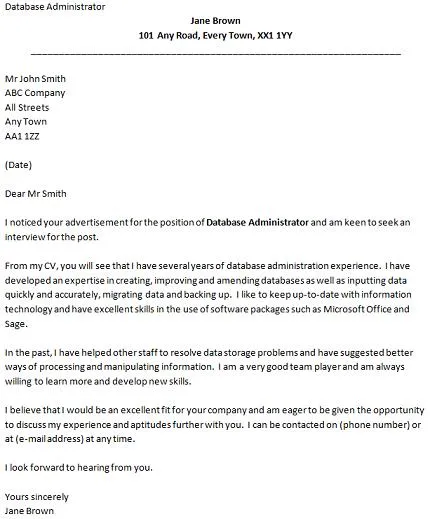
A Database Administrator cover letter should focus on database administration skills. Be sure to mention experience with database management, performance tuning, and database security. Highlight your skills in database backup and recovery and user management. Also, indicate your expertise in database monitoring tools.
Example 3 Database Developer
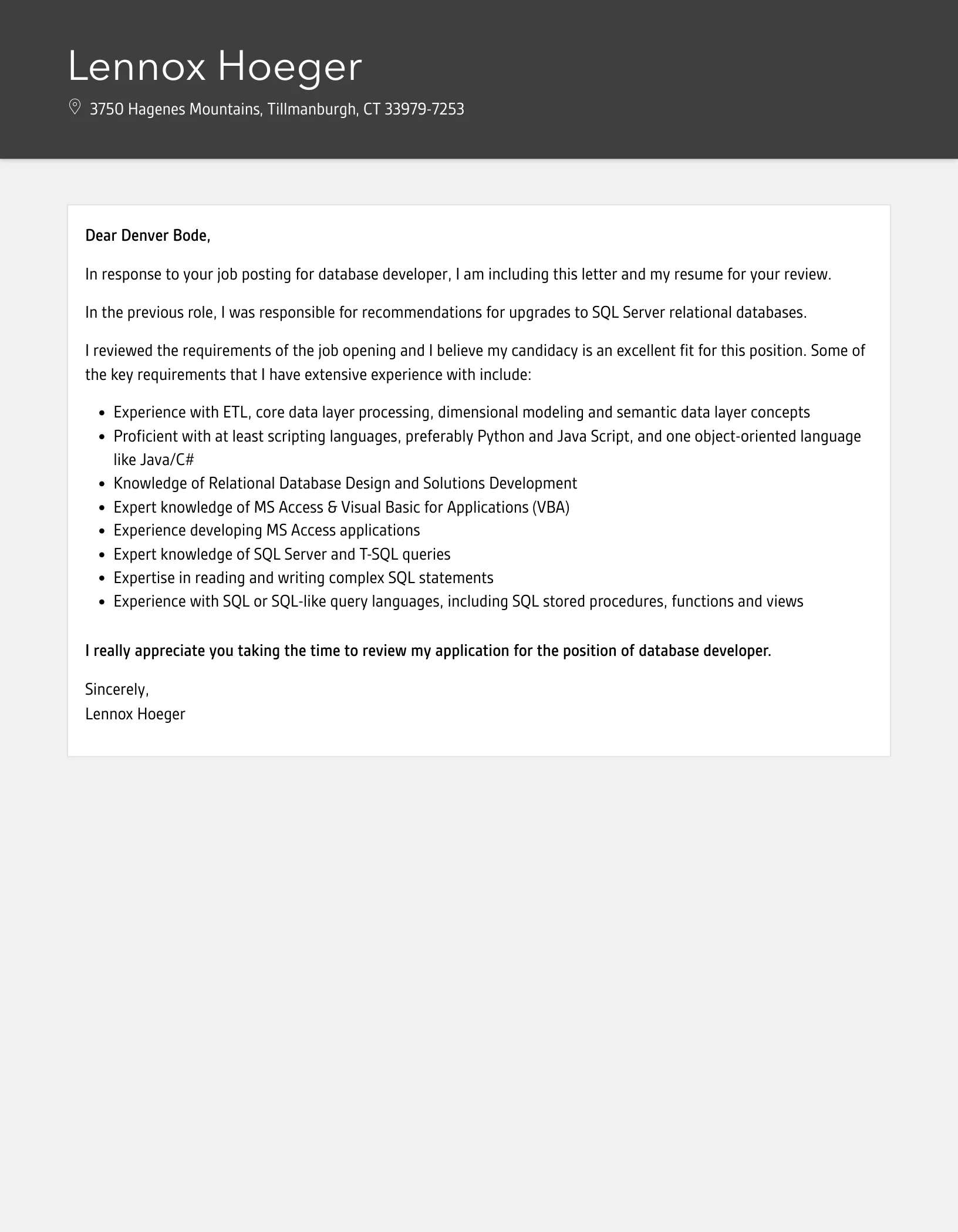
A Database Developer cover letter should demonstrate your skills in database design and development. Be sure to mention experience with SQL, database programming, and data modeling. Highlight your expertise in developing database applications and optimizing database queries. Mention your experience in the company’s tech stack. See the images “database-cover-letter-example-1”, “database-cover-letter-example-2”, and “database-cover-letter-example-3” for examples of a cover letter.
Tips for Writing a Compelling Cover Letter
Follow these tips to write a compelling database cover letter that gets you noticed. These tips can help you create a cover letter that effectively showcases your qualifications and increases your chances of securing an interview.
Research the Company
Research the company and tailor your cover letter to its mission, values, and culture. This demonstrates your genuine interest in the company. Show that you understand the company’s goals and how your skills and experience align with their needs. Tailoring your cover letter to each job helps to highlight what makes you a good fit for the company.
Emphasize Your Passion
Express your passion for the field of database management and for the specific role you are applying for. Explain why you are excited about the opportunity and how your skills and experience align with the company’s needs. Show your enthusiasm and genuine interest in the position. Your passion will resonate with the hiring manager.
Follow Up After Submission
Follow up with the hiring manager or recruiter a week or two after submitting your cover letter and resume. This demonstrates your continued interest in the position. A brief follow-up email is often sufficient. Make sure that your follow-up is professional and courteous. It will also help you reiterate your interest and enthusiasm, as well as show you are available.