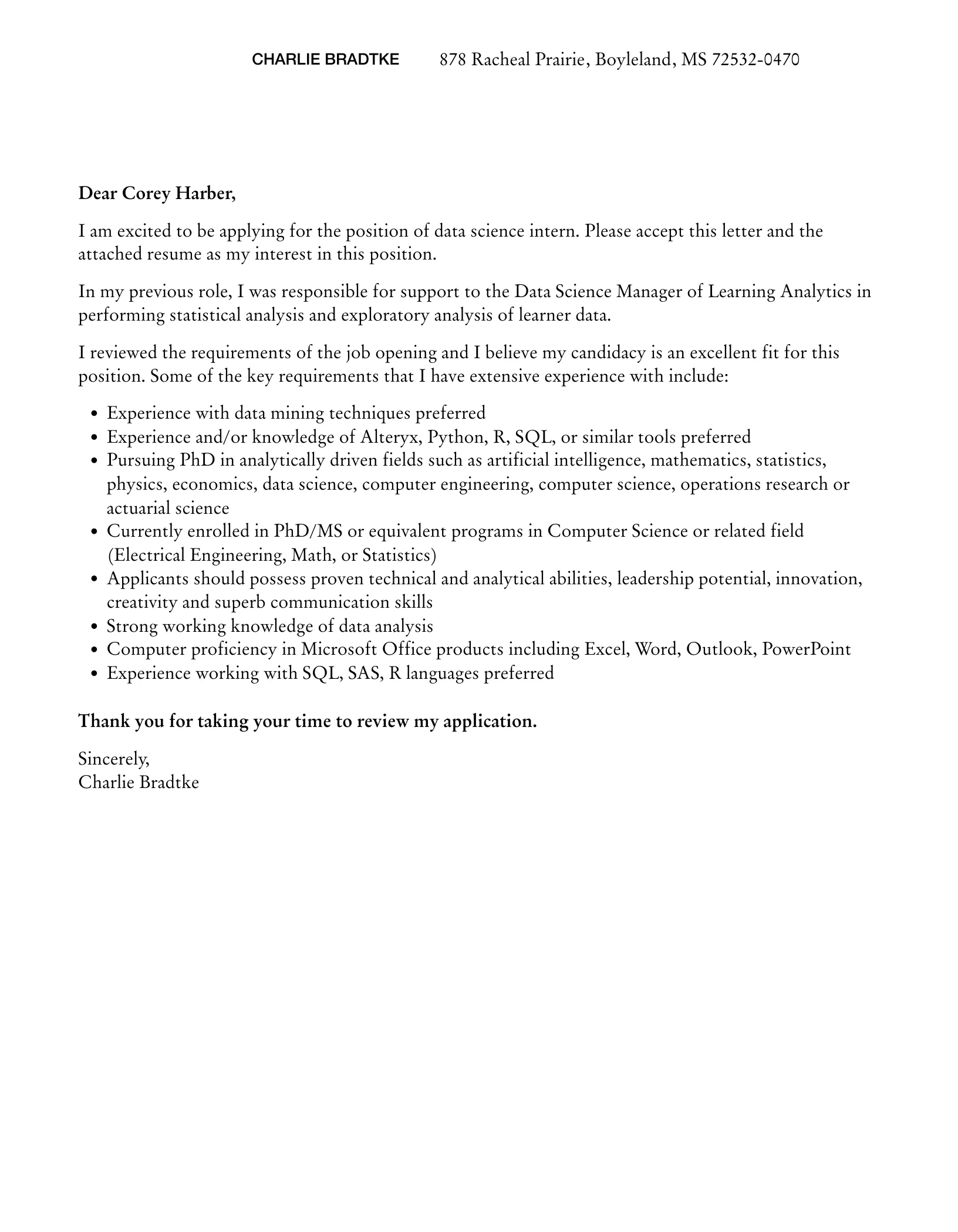
Data Science Intern Cover Letter Secrets [Must-Know]
Securing a data science internship is a significant step toward a successful career in this rapidly growing field. However, a compelling cover letter is often the key to getting your foot in the door. A well-crafted data science intern cover letter does more than just list your qualifications; it tells a story, showcasing your passion for data, your relevant skills, and your potential to contribute to the company. This guide reveals the secrets to writing a standout cover letter that grabs the attention of hiring managers and sets you apart from the competition. Whether you’re a student, recent graduate, or career changer, mastering these techniques will significantly boost your chances of landing your dream internship. Follow these secrets and watch your application rise to the top of the pile.
Understand the Purpose of a Cover Letter
Before diving into the specifics, it’s crucial to understand the purpose of a cover letter. It’s not merely a summary of your resume; it’s a chance to provide context, express your enthusiasm, and explain why you’re the ideal candidate for the role. Your cover letter offers a space to highlight your personality, communication skills, and genuine interest in the company and the data science field. It gives you a unique opportunity to illustrate how your skills and experiences align with the internship requirements. By showing, rather than just telling, you can make a strong first impression and secure an interview. Think of your cover letter as your personal introduction, where you can create a compelling narrative that sets you apart. It is about connecting with the employer on a human level.
Highlight Relevant Skills

Your data science intern cover letter must spotlight the skills that align with the job description. Review the internship requirements carefully and identify the key skills the employer is seeking. These may include programming languages (Python, R), statistical analysis, machine learning, data visualization, and data manipulation techniques. In your cover letter, provide specific examples of how you’ve utilized these skills in your projects or academic coursework. Instead of just listing the skills, describe how you’ve applied them to solve problems or achieve results. For example, if the internship requires proficiency in Python, you could mention a project where you used Python libraries like Pandas or Scikit-learn to analyze a dataset and generate actionable insights. This concrete approach demonstrates your hands-on experience and practical application of your skills. Referencing specific technologies and libraries will further impress the employer.
Showcase Projects
Projects are the backbone of any data science intern cover letter. Include details about projects that demonstrate your ability to apply your skills to real-world problems. Describe the scope of the project, your role, the methodologies you used, and the results you achieved. Whether it’s a personal project, academic assignment, or a project from a previous internship, make sure it highlights your analytical capabilities and problem-solving skills. If possible, quantify your achievements by mentioning metrics like accuracy improvements, time savings, or the impact of your insights. For instance, if you built a predictive model, specify the model’s accuracy and how it improved upon previous methods. Providing specific details about your project and the outcomes will demonstrate your ability to think critically and deliver results.
Quantify Your Achievements
Numbers speak louder than words when it comes to showcasing your achievements. Whenever possible, quantify your accomplishments to provide concrete evidence of your capabilities. Instead of saying, “Improved model accuracy,” state “Improved model accuracy by 15%.” Use metrics to highlight the impact of your work. Include specific examples of your achievements such as time saved through automation or increased efficiency due to your insights. Quantifying your achievements allows employers to evaluate your contribution’s real value and see the tangible results of your work. It’s also important to use industry-specific metrics, such as conversion rates, customer satisfaction scores, or prediction accuracy, when possible. Quantifiable results instantly elevate your application and show employers that you are result-oriented and focused on making a measurable impact.
Tailor to the Company

One of the most critical data science intern cover letter secrets is tailoring your letter to the specific company and internship. Generic cover letters are easily recognizable and often discarded. Research the company, understand its mission, values, and the projects it works on. Then, customize your cover letter to show how your skills and interests align with the company’s needs. Refer to the company’s specific products, services, or recent news to demonstrate that you’ve done your homework and are genuinely interested in joining their team. Explain why you are interested in the company and what you hope to gain from the internship. Highlighting how your skills and experiences align with the company’s specific goals and projects will create a compelling narrative, making your application much more memorable. Tailoring the letter shows your dedication.
Formatting and Structure
A well-formatted cover letter is easy to read and leaves a positive impression. Use a professional font like Arial or Times New Roman, with a font size between 10 and 12 points. Keep your cover letter concise and focused, aiming for one page. Use clear headings and bullet points to break up large blocks of text and improve readability. Make sure your cover letter is well-organized, with a logical flow. Structure it into distinct sections. A well-structured cover letter is easier for the hiring manager to review and gives a professional appearance. Proper formatting also ensures that your key messages get across effectively, making your application more impactful.
Introduction
Start your cover letter with a strong introduction that grabs the reader’s attention. State the position you’re applying for and where you found the listing. Then, briefly mention why you’re interested in the internship and the company. In the opening paragraph, highlight your most relevant skill or experience to hook the reader. Be enthusiastic and show your genuine interest in the opportunity. It’s important to let the hiring manager know immediately why you are writing and what you are applying for. Your introduction is your first chance to create a positive impression and set the tone for the rest of the letter. Keep it concise and impactful.
Body Paragraphs

The body of your cover letter should expand on your qualifications and experiences. Use the body paragraphs to elaborate on your skills, projects, and achievements. Provide specific examples that demonstrate your abilities and the impact you’ve made. Align your experiences with the internship requirements mentioned in the job description. Use keywords from the job posting to ensure your cover letter matches what the employer is looking for. Each paragraph should focus on a specific aspect of your candidacy, making your letter easy to follow. Be detailed, but keep the tone focused and concise. Use clear language and avoid overly technical jargon.
Closing
Conclude your cover letter with a strong closing that summarizes your interest and expresses your enthusiasm. Reiterate your value proposition and why you’re a good fit for the internship. Thank the hiring manager for their time and consideration. Include a call to action, such as inviting them to review your resume or expressing your eagerness for an interview. Keep it professional and show your eagerness to move forward. Provide your contact information, including your email and phone number. Ensure your closing leaves a lasting positive impression, leaving no doubt that you are the best candidate.
Proofread and Edit
Proofreading and editing are critical steps in the cover letter writing process. Carefully review your cover letter for any grammatical errors, spelling mistakes, and typos. Ensure the language is clear, concise, and professional. Read your cover letter aloud to catch any awkward phrasing or sentences that don’t flow well. Ask a friend, professor, or career counselor to review your cover letter for feedback. A fresh set of eyes can often spot errors you might miss. Pay close attention to the details and make sure your cover letter is polished and error-free. A well-proofread cover letter shows attention to detail, which is essential in data science.
Keywords and SEO Optimization

Use keywords related to data science, the specific role, and the skills required to optimize your cover letter. Integrate keywords naturally throughout your cover letter, but avoid keyword stuffing. Place the most relevant keywords in your introduction and body paragraphs. Mention specific tools, technologies, and methodologies, as mentioned in the job description. Use a keyword research tool to identify the most relevant keywords to increase your application’s visibility. Although a cover letter is not an SEO exercise, using relevant keywords can improve your application’s chances of being noticed. However, make sure that the focus is on providing a compelling and informative narrative about your skills and experience.
In conclusion, writing a data science intern cover letter is about more than just listing your qualifications. It’s about showcasing your passion, tailoring your application, and demonstrating your potential. By following these data science intern cover letter secrets, you can create a compelling cover letter that grabs the attention of hiring managers and sets you apart from the competition. Remember to highlight relevant skills, showcase your projects, quantify your achievements, and tailor your letter to the specific company. Proofread carefully, use keywords appropriately, and you’ll be well on your way to landing your dream internship. Best of luck with your applications!