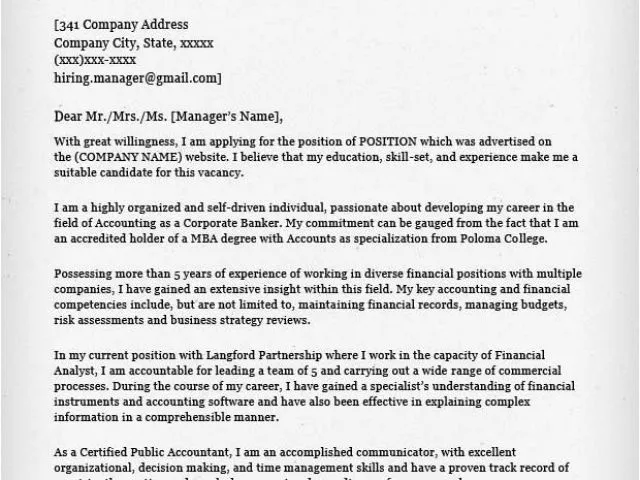
Understanding the CPA Cover Letter
A CPA cover letter is more than just a formality it’s your first impression on a potential employer. It’s your chance to showcase your personality, passion for accounting, and the specific value you bring to the role. Unlike a resume, which lists your qualifications, a cover letter allows you to tell your story and explain why you’re the perfect fit for the job. A well-crafted cover letter can significantly increase your chances of landing an interview, making it a critical part of your job application process. Think of it as a personalized introduction that goes beyond the facts listed in your resume, offering insights into your professional goals and aspirations within the field of Certified Public Accounting.
Why a CPA Cover Letter Matters
In a competitive job market, a CPA cover letter provides a crucial opportunity to differentiate yourself. It allows you to highlight how your skills and experiences align with the specific requirements of the job. It shows the hiring manager that you’ve taken the time to understand their needs and are genuinely interested in the position. A well-written cover letter demonstrates your communication skills, attention to detail, and your proactive approach to job seeking. It’s also a chance to address any potential gaps in your resume or explain career transitions, providing context that a resume alone cannot convey. The cover letter gives you space to express your enthusiasm for the role and the company, which can be a deciding factor in the hiring process.
Key Components of a CPA Cover Letter

A strong CPA cover letter follows a standard format, ensuring clarity and professionalism. The key components work together to present a cohesive and compelling narrative. This includes the correct format for contact information, a compelling opening, detailed qualification highlights, and a strong closing. Each section of your cover letter plays a crucial role in your overall impression to the employer. Pay careful attention to the structure, tone, and content of each part to effectively communicate your skills and enthusiasm. Following a well-defined structure ensures that you present your information in an organized and easily digestible format. The sections outlined below are essential for crafting a cover letter that stands out and captures the hiring manager’s attention.
Contact Information and Date
Begin with your contact information at the top left or right of the page including your name, address, phone number, and professional email address. Below your information, include the date. This sets a professional tone and makes it easy for the employer to contact you. Make sure the information provided is current and accurate; this is the first point of contact for the employer. Always use a professional email address. Ensure consistency in the formatting to maintain a polished look.
Applicant’s Information
Your name, address, phone number, and email should be clearly presented at the top. This ensures that the hiring manager can easily contact you if they are interested in inviting you for an interview. Double-check all the details to ensure there are no errors. Use a professional-sounding email address. The contact information should be easily accessible.
Hiring Manager’s Information

Direct your letter to the hiring manager by name if possible. Research the company and position to find the correct recipient. If the name is not available, use a professional title like ‘Hiring Manager’ or ‘Recruiting Team’. This shows you’ve done your research and are dedicated to the application. Address the hiring manager formally using ‘Mr.’ or ‘Ms.’ along with their last name. Addressing the hiring manager by name is a great way to demonstrate your attention to detail and genuine interest in the position. This level of personalization can set you apart from the many generic applications.
Crafting a Strong Opening
Your opening paragraph is crucial for grabbing the reader’s attention. Start by stating the position you are applying for and how you learned about it. If you were referred by someone, mention their name. Immediately highlight your key qualifications and express your enthusiasm for the role. Avoid generic openings; instead, craft a sentence that showcases your understanding of the company or the specific job requirements. Make sure your opening is concise, compelling, and sets the tone for the rest of your letter. Your opening should demonstrate your genuine interest in the company and the position, setting the stage for the details to follow. Your goal is to immediately convey your suitability for the job and encourage the hiring manager to read on.
Highlighting Your Qualifications
In the body of your letter, provide specific examples that demonstrate your skills and experience. Focus on the requirements outlined in the job description and explain how your qualifications align with them. Tailor this section to each job; don’t reuse the same letter. Be specific and use quantifiable results whenever possible. Provide evidence of your knowledge of accounting principles and your ability to apply them. Emphasize the specific skills and experiences that make you a good fit. This is where you showcase your value and make the case for why they should hire you. Use examples to illustrate how you have previously achieved success in similar situations. This section is the core of your cover letter; it’s where you connect your experiences with the job requirements.
Showcasing Relevant Experience

Detail your professional history, emphasizing experiences that directly relate to the job. Mention the companies you’ve worked for, the roles you held, and the duration of your employment. Highlight the tasks you were responsible for, such as financial reporting, tax preparation, or auditing. Use action verbs to describe your duties and responsibilities. Include specific achievements and accomplishments, showing how your efforts benefited previous employers. Focus on experiences that showcase your accounting expertise and ability to perform well in the role. Your experience is one of the key factors an employer considers.
Quantifying Achievements
Use numbers and data to demonstrate your achievements and the impact of your work. Instead of saying ‘Improved efficiency,’ state ‘Improved efficiency by 15% through process automation.’ Quantify your accomplishments whenever possible, such as ‘Managed a portfolio of $5 million’ or ‘Reduced tax liabilities by $100,000’. Provide context for these numbers to demonstrate the impact of your work. Quantitative data helps showcase the value you can bring to a potential employer. These tangible metrics add credibility to your claims. This makes your accomplishments more compelling and memorable to the hiring manager.
Demonstrating Your Skills
List and describe your technical skills, such as proficiency in accounting software, knowledge of GAAP, and expertise in financial analysis. Also, mention any relevant certifications, licenses, or professional memberships. Explain how you’ve utilized these skills in past roles and how they can benefit the employer. Provide specific examples of how you’ve used your skills to solve problems or improve processes. This helps the hiring manager quickly understand your capabilities and assess your fit for the role. Your technical skills are important for your resume and a good cover letter allows you to show you know how to use the skill.
Mentioning Soft Skills

Soft skills, such as communication, teamwork, and problem-solving, are also crucial. Include examples of how you’ve demonstrated these skills in your previous roles. For example, if you’re a good communicator, mention how you’ve effectively presented complex financial information. If you are good at teamwork, describe how you’ve collaborated with colleagues on a project. Soft skills, when combined with technical skills, demonstrate your ability to integrate into a team and contribute to the company culture. Soft skills enhance your professional profile and indicate how you work with others.
Tailoring Your Letter
Customize your cover letter for each job you apply for. Review the job description carefully and highlight the skills and experiences that match the requirements. Use the same keywords as those used in the job description. Avoid using a generic cover letter; tailor it to the specific company and role. Addressing specific needs and goals will show the hiring manager that you’re genuinely interested in the position. Tailoring your letter demonstrates that you have the skills and commitment to make an impact. Generic cover letters are easily identifiable and often dismissed, while a well-tailored letter showcases your interest and suitability.
Adapting to Specific Job Requirements
Carefully examine the job description to identify the key requirements and expectations. Highlight experiences that directly align with those requirements. If the job description emphasizes specific software skills or industry knowledge, make sure you include those in your cover letter. Provide examples of how you’ve used your skills and experiences to solve problems or improve processes in previous roles. Tailoring your letter to the specific job requirements shows the hiring manager that you have carefully considered the position and that you’re a good fit. This ensures your cover letter is not only relevant but also compelling to the person hiring.
Formatting and Presentation

The layout and formatting of your cover letter are crucial. Use a professional font like Times New Roman, Arial, or Calibri. Ensure your cover letter is easy to read with a clear structure, with proper spacing and margins. Keep it concise, ideally no more than one page, unless specifically requested otherwise. Pay attention to the overall look and feel of your cover letter. A well-formatted cover letter demonstrates attention to detail and professionalism. Formatting makes your cover letter easy to read and visually appealing to the hiring manager.
Proofreading and Editing
Thoroughly proofread your cover letter for any spelling, grammatical, and punctuation errors. Errors can damage your credibility and create a negative impression. Use a spell-checker, but also read the letter aloud to catch any mistakes. Have a friend or mentor review your letter for clarity and accuracy. A well-edited cover letter reflects your professionalism and attention to detail. Proofreading is a very important step to ensure your cover letter is free of errors. Make sure your cover letter is perfect before submitting it, ensuring you leave a positive impression.
Using Action Verbs
Use strong action verbs to describe your accomplishments and responsibilities. Action verbs add energy and impact to your writing, making your cover letter more engaging. Examples of action verbs include ‘managed,’ ‘analyzed,’ ‘implemented,’ ‘reduced,’ ‘improved,’ and ‘developed’. Action verbs make your accomplishments and your cover letter more dynamic. Using action verbs makes your cover letter more compelling and shows your proactive approach to your work. Consider using action verbs that describe your tasks. Avoid overusing the same verbs; vary your language to maintain interest.
Closing with a Call to Action

Conclude your letter with a call to action, expressing your interest in an interview. Thank the hiring manager for their time and consideration. Provide your contact information again, making it easy for the employer to reach you. Be confident, but not presumptuous. A well-crafted call to action will encourage the hiring manager to contact you. The final paragraph gives you the opportunity to reiterate your interest and show you’re available to answer any questions. You want to end on a positive note.
Expressing Gratitude
End your cover letter by thanking the hiring manager for their time and consideration. Show your appreciation for the opportunity to apply for the position. Use a formal closing, such as ‘Sincerely’ or ‘Best regards’. This simple gesture of gratitude will leave a positive lasting impression. Expressing gratitude shows that you value the time and effort the hiring manager put into reviewing your application. A thank you note is a professional closing that is a very important part of your cover letter.
Sample CPA Cover Letter
Here is a basic sample CPA cover letter format to help you write your own. This is a template, so be sure to tailor it to the specific role and company. Remember to replace the bracketed information with your details. By using the sample cover letter, you can be sure to know what format to write for your cover letter. Remember to include your contact information, the hiring manager’s information, and your opening paragraph to showcase your interests. Following the format for each section is essential to create a strong impression.
Example 1 Recent Graduate
For a recent graduate, the focus should be on educational background, internships, and relevant coursework. Highlight your GPA, honors, and any specific projects or academic achievements. Include any extracurricular activities that demonstrate leadership or teamwork skills. Show your passion for accounting and your eagerness to learn and grow within the field. The cover letter should show your career objectives and your enthusiasm for the role. Demonstrate your willingness to take on new challenges and your commitment to continuous learning. Your recent graduate cover letter will highlight your academic accomplishments and enthusiasm for launching your career.
Example 2 Experienced Professional
Experienced professionals should emphasize their work history, accomplishments, and the value they bring to the company. Highlight quantifiable achievements, such as cost savings or efficiency improvements. Include details of projects, responsibilities, and significant contributions in your previous roles. Focus on demonstrating your industry expertise, leadership skills, and your ability to drive results. The cover letter should focus on your ability to excel in the role. Show the employer your expertise and the value you bring to the organization.
Common Mistakes to Avoid
Several common mistakes can significantly reduce the effectiveness of your CPA cover letter. Avoid generic language; tailor your cover letter to each job. Don’t use the same cover letter for every application. Do not exceed one page unless specifically requested. Avoid typos and grammatical errors; carefully proofread your letter. Do not provide excessive details that are already in your resume. Avoid negative statements or complaints about past employers. Always ensure that your cover letter is error-free, tailored, and demonstrates your value.
Tips for a Successful CPA Cover Letter
To increase your chances of success, follow these tips: Research the company thoroughly to tailor your letter. Use keywords from the job description. Quantify your accomplishments whenever possible. Proofread carefully for errors. Always use a professional tone and format. Customize your letter for each application. The goal is to leave a strong impression and secure an interview. Demonstrating you’ve done your research and are well-prepared. A strong cover letter is key to making an impact. Following these tips will help you create a compelling cover letter. This will help you land your dream job.