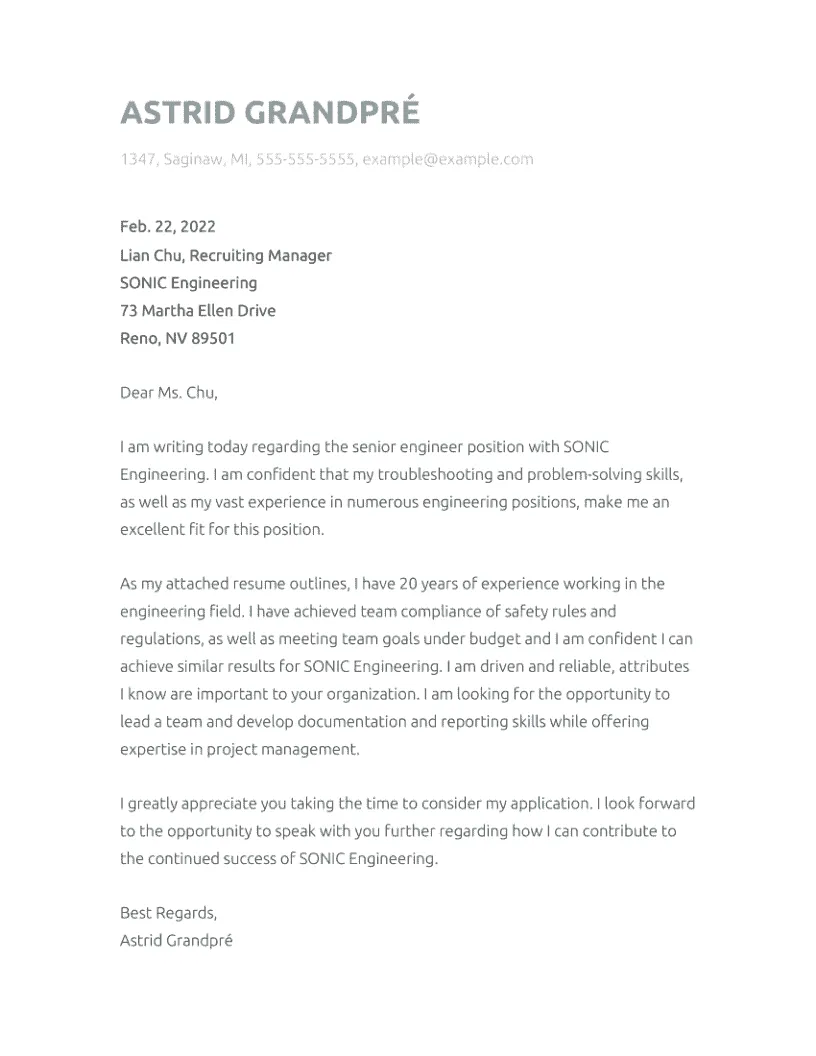
Cover Letter for Engineering Resume Why It Matters
In the competitive field of engineering, a well-crafted cover letter is not just a formality; it’s your first opportunity to make a lasting impression. Unlike a resume, which provides a snapshot of your skills and experience, a cover letter allows you to tell your story. It’s where you can highlight your passion for engineering, showcase your personality, and demonstrate how your unique skills align with the specific requirements of the role and the company. A strong cover letter for an engineering resume can significantly increase your chances of getting noticed by hiring managers, setting you apart from other applicants and paving the way for an interview. Ignoring this critical component could mean missing out on opportunities, as a generic or poorly written letter can reflect negatively on your attention to detail and communication skills, both essential qualities in engineering.
Highlighting Your Skills and Experience
Your cover letter should serve as a bridge between your resume and the job description, emphasizing the skills and experiences most relevant to the position. Start by identifying the key requirements listed in the job posting and then select specific examples from your background that showcase those skills. This isn’t just about listing your qualifications; it’s about demonstrating how you’ve applied your skills in practical situations and what results you achieved. For instance, if a job requires proficiency in CAD software, mention a project where you utilized it to design a complex system, detailing the challenges you overcame and the outcomes you delivered. Similarly, when you are presenting your skills, emphasize on projects that align with the company’s mission and values. The goal is to paint a vivid picture of how you can contribute to the company’s success, using concrete examples to back up your claims.
Tailoring Your Cover Letter for the Specific Role

Generic cover letters rarely impress hiring managers. The most effective cover letters are tailored to each specific job application. This involves carefully reviewing the job description and identifying the key skills, experiences, and qualifications the employer is seeking. Customize your letter by highlighting the aspects of your background that directly address these requirements. Show that you understand the company’s needs and how your skills and experiences align with them. If possible, research the company’s mission, values, and recent projects to demonstrate your genuine interest and to provide a tailored response that showcases your understanding of the industry and the specific role. Demonstrating a keen interest in the company helps you stand out from the crowd, which is extremely important in today’s competitive job market.
Matching Your Skills to the Job Description
When writing a cover letter for an engineering role, it’s crucial to clearly match your skills and experiences to the job description. Identify the keywords and phrases that the employer uses to describe the required qualifications, such as specific software proficiencies (e.g., AutoCAD, SolidWorks), technical skills (e.g., finite element analysis, circuit design), and project management capabilities. Then, in your letter, use those keywords to demonstrate that you possess the necessary skills. Provide concrete examples of how you’ve applied these skills in previous roles or projects. For instance, if the job requires experience with a particular type of equipment or technology, provide specific examples of how you’ve used it, what you accomplished, and how your experience directly relates to the responsibilities outlined in the job description. This approach shows the hiring manager that you not only meet the requirements but also understand the role and can contribute effectively from day one.
Quantifying Your Achievements
Instead of simply listing your responsibilities, focus on quantifying your achievements. Use numbers, percentages, and specific data to demonstrate the impact of your work. For example, instead of saying ‘Improved efficiency,’ state ‘Improved project efficiency by 15% through process optimization.’ Similarly, when showcasing your problem-solving skills, provide details like ‘Reduced system errors by 20% by implementing new testing protocols.’ Quantifying your achievements makes your cover letter more compelling and gives the hiring manager a clear understanding of your capabilities. It provides concrete evidence of your value and ability to deliver results. This approach not only demonstrates your competence but also sets you apart from other applicants who may use vague or general statements about their accomplishments. Therefore, always strive to show, not just tell, your achievements, as it is more persuasive.
Providing Measurable Results

Engineers often deal with tangible outcomes. When writing your cover letter, always aim to provide measurable results that demonstrate the impact of your work. Instead of stating ‘Successfully managed projects,’ detail what you actually achieved. For instance, describe ‘Managed a team of engineers to deliver projects on time and under budget, resulting in a 10% cost savings.’ Similarly, if you’ve contributed to innovation, state the tangible outcomes. For example, ‘Developed a new design that reduced material costs by 12% while increasing product lifespan by 8%.’ When showcasing your problem-solving capabilities, specify the outcome. Always show measurable results, as they add credibility to your claims and provide the hiring manager with a clear understanding of your impact. These metrics highlight your value and showcase your ability to drive positive change within an organization.
Showcasing Technical Proficiency
Engineering roles often require specific technical proficiencies. In your cover letter, explicitly mention the relevant software, tools, and technologies you’re skilled in, and also showcase your experience with them. Don’t just list these skills; demonstrate how you’ve used them to solve problems or achieve specific results. For example, if the job requires experience with CAD software, provide details about projects where you utilized this software, emphasizing the complexity of the designs and the outcomes achieved. Similarly, if you have experience with programming languages such as Python or MATLAB, mention specific applications and how you used them to automate processes or analyze data. Highlighting your technical proficiencies in a clear and concise manner, with practical examples, shows the hiring manager that you possess the necessary skills to excel in the role. If you have certifications, mention them as well.
Demonstrating Problem-Solving Abilities
Engineers are, at their core, problem solvers. In your cover letter, it is essential to highlight your ability to analyze complex issues, devise innovative solutions, and implement them effectively. Use specific examples from your past experiences to illustrate your problem-solving approach. Describe a challenging project you worked on, the specific problem you faced, the steps you took to analyze it, the solutions you developed, and the outcomes you achieved. If possible, mention any innovative approaches you employed or any improvements you implemented as a result of your solutions. For example, if you redesigned a system to improve efficiency, explain the previous issues and how your changes resolved them. Showcasing your problem-solving skills is critical, as it demonstrates your capacity to handle challenges, adapt to new situations, and contribute to continuous improvement within the company.
Adding a Personal Touch

While professionalism is important, adding a personal touch can help you stand out from the crowd. Show the hiring manager that you’re more than just a list of qualifications by letting your personality shine through. Share your enthusiasm for the field of engineering and what motivates you. This could be a brief anecdote about a project you’re passionate about or a description of your career goals and how they align with the company’s values. Use a conversational tone and avoid sounding robotic or generic. This doesn’t mean being overly casual; it means finding the right balance between professionalism and authenticity. Demonstrating your enthusiasm and personal connection to the work helps create a memorable impression and shows the hiring manager that you’re not only qualified but also a great fit for the company culture.
Expressing Enthusiasm for the Company
Show genuine enthusiasm for the company you’re applying to by expressing your interest in their work, their values, and their mission. Research the company thoroughly and identify specific projects, products, or initiatives that resonate with you. Mention these in your cover letter to show that you understand and appreciate their work. This could involve highlighting a recent project you admire, mentioning a specific company value that aligns with your personal values, or discussing how you can contribute to their future goals. Expressing enthusiasm demonstrates that you are genuinely interested in the opportunity and not just sending out a generic application. This level of personalization demonstrates that you’ve invested time and effort into the application, making you a more appealing candidate. Also, a well-researched letter shows your commitment and passion for the role and the company.
Proofreading and Formatting Your Cover Letter
A polished cover letter is a reflection of your attention to detail, a crucial skill in engineering. Before submitting your application, carefully proofread your cover letter to eliminate any grammatical errors, spelling mistakes, or typos. Read it multiple times, and ideally, have someone else review it as well. The format of your cover letter should be clear, professional, and easy to read. Use a standard font, such as Arial or Times New Roman, and maintain consistent formatting throughout. Divide your content into logical paragraphs with clear headings and subheadings to make it easy for the hiring manager to scan and understand the key points. A well-formatted and error-free cover letter enhances your credibility and demonstrates your commitment to excellence, which is essential in the field of engineering.
Ensuring Clarity and Conciseness

Clarity and conciseness are key to an effective cover letter. Engineers often deal with complex concepts, so it’s important to communicate your skills and experiences in a clear and straightforward manner. Avoid using overly complex language or jargon that the hiring manager may not understand. Use short, impactful sentences and paragraphs to convey your message efficiently. Keep your cover letter focused on the most relevant information and avoid unnecessary details. The goal is to highlight your qualifications quickly and persuasively, so the hiring manager can easily understand your value. Proofread your letter carefully and remove any unnecessary words or phrases. Ensuring your cover letter is easy to read and understand increases the chances of the hiring manager quickly grasping the key points and deciding to move forward with your application.
Including a Call to Action
Include a clear call to action at the end of your cover letter to guide the hiring manager. Let them know what you want them to do next. A well-written call to action can prompt the hiring manager to take the next step, such as contacting you for an interview or reviewing your resume in more detail. A call to action is a direct request for a specific action. This gives the hiring manager a clear direction and makes it easy for them to move forward with your application. A strong call to action, along with the previous tips, gives you a significant edge over other candidates.
Requesting an Interview
At the end of your cover letter, explicitly request an interview. This shows your interest and eagerness to discuss your qualifications in more detail. Thank the hiring manager for their time and consideration, and express your enthusiasm for the opportunity. Provide your contact information again, making it easy for them to reach you. Reiterate your interest in the position and the company, reinforcing your enthusiasm and commitment. You can use a statement like ‘I am eager to discuss my qualifications further and would welcome the opportunity to interview for this position. Thank you for your time and consideration. I can be reached at [your phone number] or [your email address].’ This clear and direct request increases the likelihood of receiving an interview and moving forward in the hiring process.
Cover Letter for Engineering Resume Final Thoughts

Writing a compelling cover letter for an engineering resume is a critical step in securing your desired job. By highlighting your skills, experiences, and achievements and matching them with the requirements of the role, you can create a powerful narrative that captures the attention of hiring managers. Always remember to tailor your letter to each specific job, quantify your results, showcase your technical proficiency, demonstrate your problem-solving abilities, and express your genuine enthusiasm for the company. A well-crafted cover letter will set you apart from other candidates and give you a significant advantage in the competitive engineering job market. By following the tips outlined above, you’ll be well on your way to writing a cover letter that not only gets you noticed but also lands you your dream job.