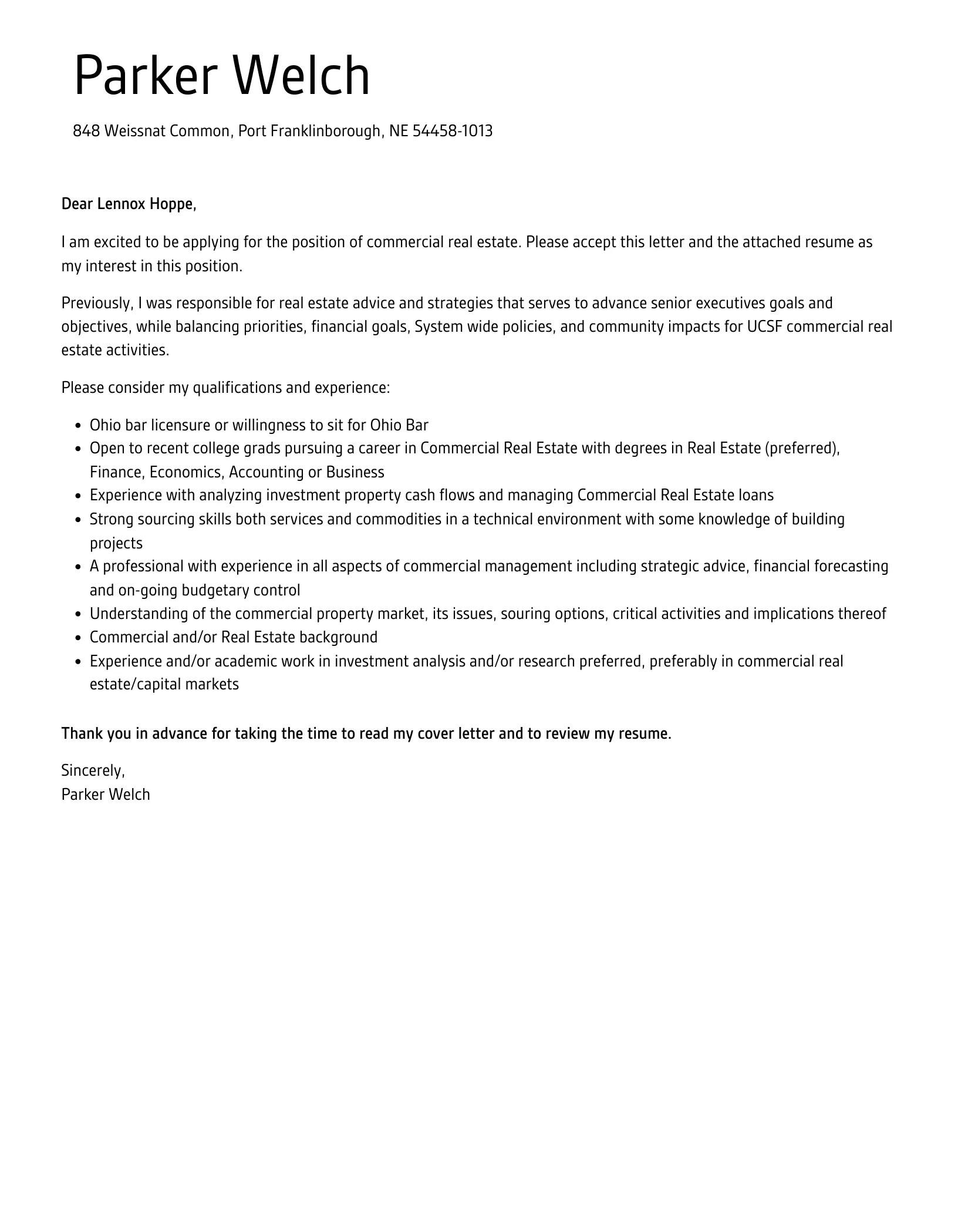
Commercial Real Estate Cover Letter Basics
A commercial real estate cover letter is a crucial document when applying for jobs in the commercial real estate industry. It serves as your introduction, allowing you to showcase your skills, experience, and enthusiasm for the role. Unlike a resume, which provides a factual overview of your career, a cover letter gives you the opportunity to personalize your application and demonstrate how your qualifications align with the specific requirements of the position. A well-crafted cover letter can significantly increase your chances of securing an interview and ultimately landing your desired job. It’s your first impression, and it needs to be a good one.
Understanding the Purpose of a Cover Letter
The primary purpose of a cover letter is to introduce yourself to a potential employer and express your interest in a specific job. It provides context to your resume, explaining why you are the ideal candidate for the position. A cover letter allows you to highlight your most relevant skills and experiences, demonstrate your understanding of the industry, and showcase your personality and communication style. It is also an opportunity to explain any gaps in your employment history or address any concerns the employer may have. Furthermore, a well-written cover letter demonstrates your professionalism, attention to detail, and commitment to the application process.
Key Components of a Cover Letter

A strong cover letter includes several key components that work together to create a compelling narrative. These include a professional header with your contact information, a formal salutation addressing the hiring manager or company representative, an engaging opening paragraph that grabs the reader’s attention, body paragraphs that highlight your relevant experience and skills, and a concise closing paragraph with a call to action. Each section plays a vital role in conveying your qualifications and persuading the employer to consider your application further. Remember to tailor each component to the specific job and company for which you are applying.
Essential Information to Include
Your cover letter should provide essential information that demonstrates your suitability for the role. This includes a brief overview of your relevant work experience, highlighting your key accomplishments and responsibilities. Emphasize the skills and qualifications that align with the job description, such as market analysis, financial modeling, negotiation, or property management. Quantify your achievements whenever possible, providing specific examples of how you have contributed to previous employers. Additionally, express your enthusiasm for the company and the specific position, demonstrating your understanding of their mission and values. Finally, include a clear call to action, inviting the employer to review your resume and contact you for an interview.
Commercial Real Estate Cover Letter Structure
A well-structured cover letter is easy to read and effectively conveys your message. The structure follows a logical flow, starting with your contact information and ending with a call to action. Each section should serve a specific purpose, guiding the reader through your qualifications and demonstrating your suitability for the position. Following a clear structure allows you to present your information in a concise and organized manner, making it easier for the hiring manager to assess your application. A well-formatted cover letter will make a strong impression.
Header and Contact Information

Begin your cover letter with a professional header that includes your full name, address, phone number, and email address. You can place this information at the top left or right corner of the page, ensuring it is easy to find. The header should be clean and well-formatted, reflecting your attention to detail. Ensure that the contact information is accurate and up-to-date so that the employer can easily reach you. You can also include the date and the company’s address below your contact information, demonstrating your professionalism and adherence to business etiquette. Always use a professional email address.
Professional Salutation
Use a professional salutation to address the hiring manager or the specific person responsible for reviewing applications. Research the company to identify the appropriate contact person. If you cannot find a name, use a formal greeting like “Dear Hiring Manager” or “Dear [Department Name] Team.” Avoid generic greetings like “To Whom It May Concern,” which can make your application feel impersonal. Always spell the person’s name correctly, and double-check your spelling and punctuation. A proper salutation sets a professional tone for the rest of your cover letter.
Opening Paragraph
The opening paragraph should immediately grab the reader’s attention and express your interest in the position. Clearly state the specific job you are applying for and where you found the listing. Briefly mention something that sparked your interest in the company or the role. You can also include a brief summary of your key qualifications and experience, but avoid repeating information from your resume. The goal of the opening paragraph is to create a positive first impression and encourage the hiring manager to continue reading. Show enthusiasm and a clear understanding of the role.
Body Paragraphs Highlighting Experience

The body paragraphs are the heart of your cover letter, where you showcase your relevant experience and skills. Focus on the experiences that align with the job requirements, providing specific examples of your accomplishments and responsibilities. Use the STAR method (Situation, Task, Action, Result) to provide context to your achievements. Quantify your achievements whenever possible by including metrics and data to demonstrate your impact. Tailor each paragraph to address the specific requirements of the job description. Ensure that your writing is clear, concise, and easy to understand. Highlight your key strengths and skills, such as financial analysis, negotiation, market research, and property management.
Quantifiable Achievements
Quantifiable achievements are crucial for demonstrating your impact and value to a potential employer. Provide specific numbers, percentages, and data points to illustrate your accomplishments. For instance, instead of saying “Increased sales,” say “Increased sales by 15% in Q3, exceeding the quarterly target.” Instead of saying “Managed properties,” say “Managed a portfolio of 10 properties with a total value of $50 million, resulting in a 95% occupancy rate.” Quantifying your achievements adds credibility to your claims and makes your cover letter more persuasive. Numbers speak volumes.
Tailoring Your Cover Letter
Customizing your cover letter for each job application is essential. Do not use a generic cover letter; instead, tailor it to the specific requirements of each position and company. Research the company and the role to understand their needs and priorities. Review the job description carefully and identify the key skills and qualifications that are most important. Use the language and keywords from the job description in your cover letter. Show how your skills and experience align with the employer’s needs. Tailoring your cover letter demonstrates your genuine interest in the role and your understanding of the company’s requirements. Address the company’s specific needs and show that you’ve done your homework.
Closing Paragraph and Call to Action

The closing paragraph should summarize your interest in the position and reiterate your key qualifications. Thank the hiring manager for their time and consideration. Include a clear call to action, such as inviting the employer to review your resume and contact you for an interview. Provide your contact information again, making it easy for the employer to reach you. Express your enthusiasm for the opportunity and your eagerness to discuss your qualifications further. End with a professional closing, such as “Sincerely” or “Best regards,” followed by your full name.
Formatting and Design
Pay close attention to the formatting and design of your cover letter. Choose a professional font, such as Times New Roman, Arial, or Calibri, and use a font size between 10 and 12 points. Use consistent margins and spacing throughout the document. Keep the cover letter concise, ideally no more than one page. Use clear and concise language, avoiding jargon and overly complex sentences. Proofread your cover letter carefully for any errors in grammar, spelling, and punctuation. The formatting and design should enhance readability and create a positive impression. Consider using bullet points to highlight key skills and accomplishments.
Cover Letter Examples
Reviewing commercial real estate cover letter samples can provide valuable insights and guidance. The examples can provide you a clear understanding of how to structure a cover letter effectively and tailor it to different positions within the industry. Look at examples for various roles, such as brokers, analysts, and property managers, to see how the language and content change based on the specific job requirements. Study successful cover letters to identify best practices, such as highlighting relevant skills, quantifying achievements, and expressing enthusiasm for the company and the role. Modify the examples based on your skills, experience, and the job you’re applying for. Use these samples as a foundation for your own cover letters.
Sample Cover Letter for a Brokerage Position

A cover letter for a brokerage position should emphasize your sales skills, negotiation abilities, and market knowledge. Highlight your experience in building relationships, generating leads, and closing deals. Include details about any specific property types you specialize in, such as retail, office, or industrial. Showcase your understanding of market trends and your ability to identify and capitalize on opportunities. Mention your experience in networking and attending industry events. Quantify your sales achievements by providing the value of deals closed or the percentage increase in sales. Show you have a strong understanding of the local market and relevant regulations.
Sample Cover Letter for an Analyst Role
A cover letter for an analyst role should emphasize your analytical skills, financial modeling abilities, and understanding of real estate finance. Highlight your experience in conducting market research, analyzing financial statements, and preparing investment proposals. Mention your experience in using financial modeling software and your ability to interpret complex data. Showcase your understanding of real estate valuation and investment strategies. Quantify your achievements by providing examples of how you’ve helped clients make informed investment decisions or improve financial performance. Demonstrate your ability to work independently and as part of a team.
Sample Cover Letter for a Property Manager Position
A cover letter for a property manager position should emphasize your experience in managing properties, handling tenant relations, and overseeing maintenance and repairs. Highlight your experience in budgeting, lease administration, and ensuring tenant satisfaction. Mention your experience in coordinating with vendors, managing property finances, and ensuring compliance with regulations. Showcase your skills in problem-solving, communication, and leadership. Quantify your achievements by providing metrics such as occupancy rates, tenant retention rates, and cost savings. Demonstrate your ability to create a positive and well-maintained environment for tenants.
Tips for Proofreading and Editing

Proofreading and editing your cover letter is critical to ensuring that it is polished and professional. Errors in grammar, spelling, and punctuation can create a negative impression and undermine your credibility. Review your cover letter carefully for any mistakes. Read your cover letter aloud to catch any awkward phrasing or unclear sentences. Ask a friend, colleague, or career counselor to review your cover letter and provide feedback. Pay attention to details, such as the correct use of capitalization, punctuation, and formatting. Make sure that the language and tone are professional and appropriate for the industry. Proofreading and editing demonstrate your attention to detail and your commitment to presenting yourself in the best possible light.
Common Mistakes to Avoid
Avoid common mistakes that can detract from your cover letter. Do not use generic cover letters; always tailor them to the specific job and company. Do not repeat information from your resume verbatim; use the cover letter to provide additional context and highlight your most relevant skills. Avoid using jargon or overly complex language. Do not use slang or casual language. Avoid including negative information about previous employers or colleagues. Avoid grammatical errors, spelling mistakes, and formatting issues. Do not exceed the one-page limit. Carefully proofread your cover letter for any errors before submitting it.
Ensuring Accuracy and Clarity
Ensuring accuracy and clarity is essential for creating a successful cover letter. Verify that all your contact information is correct and up-to-date. Double-check the spelling of the hiring manager’s name and the company’s name. Use clear and concise language, avoiding jargon and overly complex sentences. Make sure your sentences are well-structured and easy to understand. Use proper grammar and punctuation. Proofread your cover letter carefully for any errors. Have someone else review your cover letter to ensure accuracy and clarity. A well-written and error-free cover letter will make a positive impression and increase your chances of getting an interview.