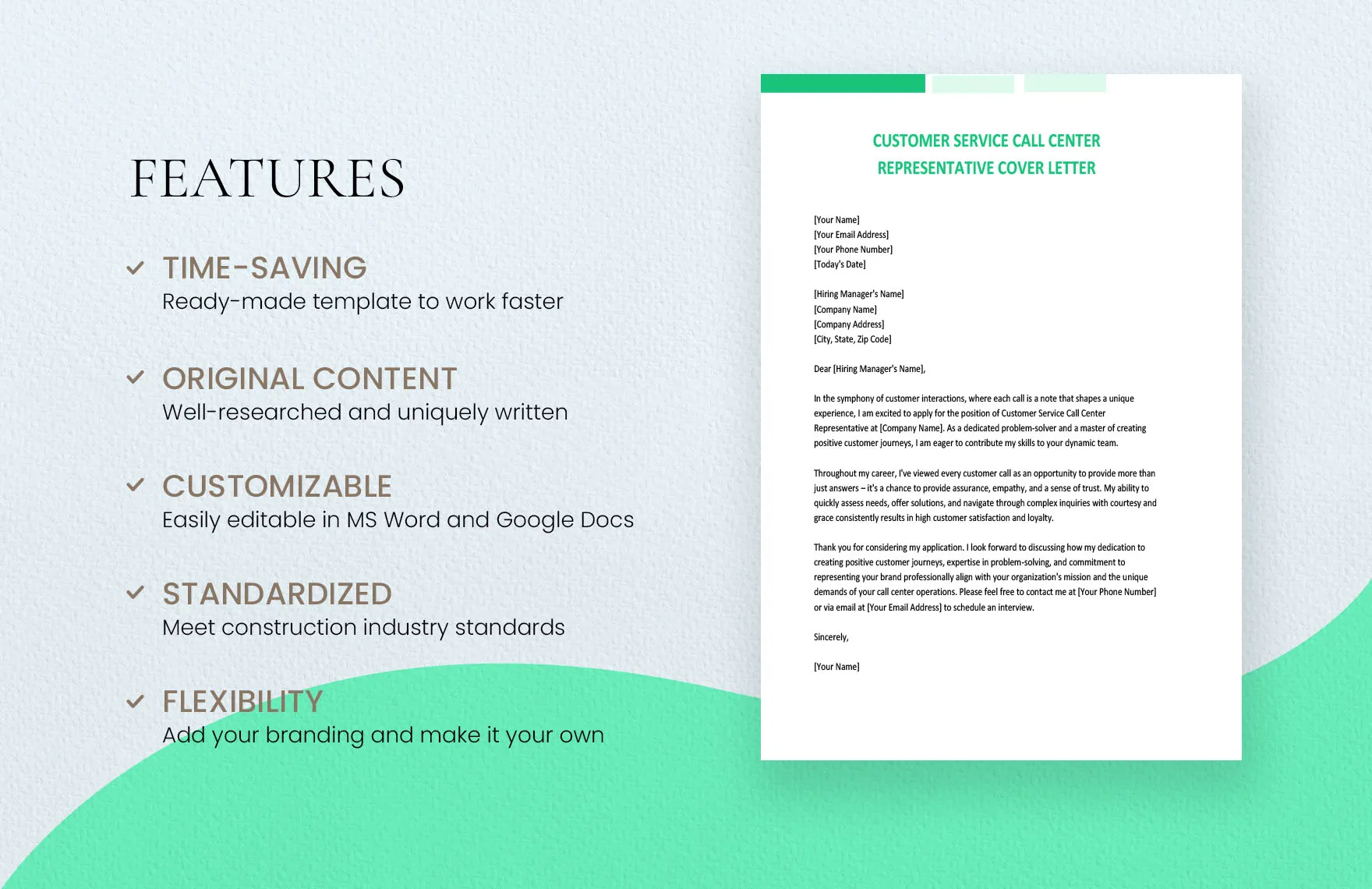
What is a Call Centre Representative Cover Letter
A call centre representative cover letter is a crucial document that accompanies your resume when applying for a call centre position. It serves as your introduction to the hiring manager, providing an opportunity to highlight your relevant skills, experience, and enthusiasm for the role. Unlike a resume, which provides a factual overview of your background, a cover letter allows you to express your personality, demonstrate your understanding of the job requirements, and explain why you are the ideal candidate. It is your chance to make a great first impression and convince the employer to consider your application seriously. The cover letter should be clear, concise, and tailored to the specific call centre position you are applying for.
Why You Need a Strong Cover Letter
In a competitive job market, a strong cover letter can significantly increase your chances of getting noticed. It’s not just about stating your qualifications; it’s about demonstrating your passion, skills, and understanding of the company’s needs. A well-written cover letter shows that you have taken the time to research the role and the company, making you stand out from other applicants. Moreover, it allows you to expand on the information in your resume, providing context and depth to your experiences. It also showcases your written communication skills, which are essential for a call centre representative. If your cover letter is poorly written or generic, it could lead to your application being overlooked, so a strong cover letter is essential.
Key Components of a Call Centre Cover Letter

A successful call centre representative cover letter includes several key components. These elements work together to create a compelling narrative that highlights your suitability for the role. The structure helps organize your thoughts and present yourself professionally. Each section plays a vital role in persuading the hiring manager that you are the best choice. These components include the header and contact information, the greeting, the opening paragraph, the body paragraphs where you highlight skills and experience, and the closing paragraph. Adhering to a standard structure ensures that you cover all the necessary points and present a polished, professional image.
Header and Contact Information
The header should include your full name, contact number, email address, and, optionally, your LinkedIn profile URL. This ensures that the hiring manager can easily reach you. Ensure the information is accurate and up-to-date. Place this information at the top of your cover letter, typically aligned to the left or right. The inclusion of your contact information is crucial for an easy follow-up by the employer. Always double-check for any typos or errors in your contact information, as this could prevent the employer from contacting you.
Greeting the Hiring Manager
Address the hiring manager or the specific person listed in the job posting whenever possible. Use “Dear Mr./Ms. [Last Name]” if you know their name. If you cannot find a name, use a generic greeting like “Dear Hiring Manager.” Avoid overly casual greetings such as “Hi there.” A personalized greeting demonstrates that you have taken the time to research the company and the role. If the job description does not provide a name, you can often find the hiring manager’s name by checking the company website, LinkedIn, or other sources. It is all about making a good first impression.
Opening Paragraph

Start with a strong opening that grabs the reader’s attention. State the position you are applying for and where you found the job posting. Briefly mention why you are interested in the role and the company. Highlight your key skills or experiences that make you a good fit. This paragraph sets the tone for your cover letter and creates a positive first impression. A compelling opening immediately captures the hiring manager’s attention and encourages them to read the rest of your letter. For example, “I am writing to express my keen interest in the Call Centre Representative position advertised on [Platform]. With my proven communication skills and dedication to providing exceptional customer service, I am confident I can contribute significantly to your team.”
Highlighting Relevant Skills and Experience
The body of your cover letter is where you showcase your skills and experience. Focus on the skills that are most relevant to the call centre representative role. Provide specific examples to illustrate your abilities and accomplishments. Quantify your achievements whenever possible (e.g., “Improved customer satisfaction by 15%”). Relate your experiences to the job requirements outlined in the job description. Use keywords from the job posting to ensure your cover letter aligns with what the employer is seeking. Be specific and avoid vague statements. Providing solid examples of your past accomplishments will help convince the recruiter.
Communication Skills
Excellent communication skills are critical for call centre representatives. Highlight your ability to listen effectively, speak clearly and concisely, and write professionally. Mention any experience you have in handling difficult customers or resolving conflicts. Provide examples of situations where you used your communication skills to achieve positive outcomes. Your ability to convey information clearly and empathetically is essential. Mention any training or certifications related to communication or active listening. Showing how you adapt your communication style to different situations or customers also demonstrates that you are a flexible and adaptable candidate. For instance, you can explain how you communicate a solution in a professional way.
Customer Service Abilities

Customer service skills include patience, empathy, and the ability to handle customer inquiries and complaints effectively. Describe your experience in providing excellent customer service. Showcase your ability to go above and beyond to resolve issues and exceed customer expectations. Mention any awards or recognition you have received for outstanding customer service. Detail how you have consistently met or exceeded customer satisfaction metrics. You might describe the processes you have followed to solve customer issues. Highlight how you turn negative experiences into positive ones.
Technical Proficiency
Call centre representatives need to be comfortable using computers, phone systems, and various software applications. List any technical skills relevant to the job. Specify your experience with CRM software, data entry, or other relevant tools. Mention any training or certifications related to technical skills. This shows your ability to learn and adapt to different technologies. For instance, you might mention that you are proficient in using specific software or phone systems. Highlighting your ability to troubleshoot technical issues also demonstrates your skills. Add the name of the software you are comfortable with and the time you have used it.
Emphasizing Achievements and Quantifiable Results
Whenever possible, quantify your achievements to demonstrate your impact. Use numbers and statistics to highlight your successes. Instead of saying “Improved customer satisfaction,” say “Improved customer satisfaction by 15%.” Provide concrete examples of how you have achieved results in previous roles. This could include metrics such as call resolution rates, sales figures, or customer retention rates. Quantifiable results make your claims more credible and show the hiring manager the value you can bring to the company. Presenting your achievements in quantifiable terms provides a clear understanding of your capabilities and potential value.
Tailoring Your Letter to the Job Description

Customizing your cover letter for each job application is crucial. Tailoring your cover letter to each specific job description demonstrates that you have taken the time to understand the role and the company. Highlight the skills and experiences that align with the requirements outlined in the job posting. Avoid using a generic cover letter. Instead, show how your qualifications match the specific needs of the company. Ensure that your letter addresses the key requirements mentioned in the job description. Customization shows your interest in the position and the company.
Researching the Company
Before writing your cover letter, research the company. Visit their website, read about their mission, values, and recent news. This knowledge will help you tailor your letter and demonstrate your genuine interest. Show how your skills and experience align with the company’s goals and culture. Mention specific aspects of the company that appeal to you. Mentioning something specific shows you’re genuinely interested in the company. This research allows you to create a more personalized and impactful cover letter. This effort shows you have a professional approach.
Addressing Specific Requirements
Carefully review the job description and address each requirement in your cover letter. Use the same keywords and phrases as the job posting when describing your skills and experience. If the job description asks for experience with a specific software, make sure to highlight your relevant experience. Ensure that your cover letter explicitly addresses the key responsibilities and qualifications outlined in the job posting. This demonstrates that you can fulfill the role and align with the needs of the company. A targeted cover letter significantly increases your chances of success.
Formatting and Presentation

The formatting and presentation of your cover letter are important for making a good impression. A well-formatted cover letter is easier to read and more professional in appearance. Use a clean and readable font, standard margins, and consistent spacing. Avoid using excessive formatting or distracting elements. Ensure your cover letter is well-organized and easy to navigate. Proper formatting enhances the readability and professionalism of your cover letter.
Font and Readability
Choose a professional and readable font, such as Times New Roman, Arial, or Calibri. Use a font size between 10 and 12 points. Use standard margins (1 inch on all sides) and single-spacing for the body of your letter. Ensure there is sufficient space between paragraphs. Avoid using overly decorative or unusual fonts. The readability of your cover letter is important for conveying your message effectively. Consistent formatting enhances the reader’s experience and helps to create a positive impression.
Proofreading and Editing
Always proofread your cover letter carefully for any grammatical errors, spelling mistakes, and typos. Check for consistency in formatting and language. Ask someone else to review your letter for a fresh perspective. Use grammar and spell-checking tools, but don’t rely on them completely. A well-proofread cover letter demonstrates your attention to detail and professionalism. Errors can detract from your qualifications and make a negative impression. This will make sure there aren’t any mistakes.
Closing the Letter

The closing of your cover letter is an opportunity to reiterate your interest and encourage the hiring manager to take action. Express your enthusiasm for the role and the company. Thank the hiring manager for their time and consideration. Include a call to action, such as requesting an interview. The closing should be concise, professional, and leave a lasting positive impression. Make sure it is a good closing.
Call to Action
Include a clear call to action, such as “I am eager to discuss my qualifications further in an interview.” Or you can also include something like, “I am available for an interview at your earliest convenience.” This encourages the hiring manager to take the next step in the hiring process. Make it easy for the hiring manager to contact you. A strong call to action increases your chances of moving forward in the application process.
Sign-off and Contact Information
Use a professional sign-off, such as “Sincerely,” or “Best regards.” Type your full name below the sign-off. Reiterate your contact information, especially your phone number and email address. Ensure your contact information is easy to find. A professional sign-off and clear contact information reinforce your professionalism and make it easy for the hiring manager to reach you.