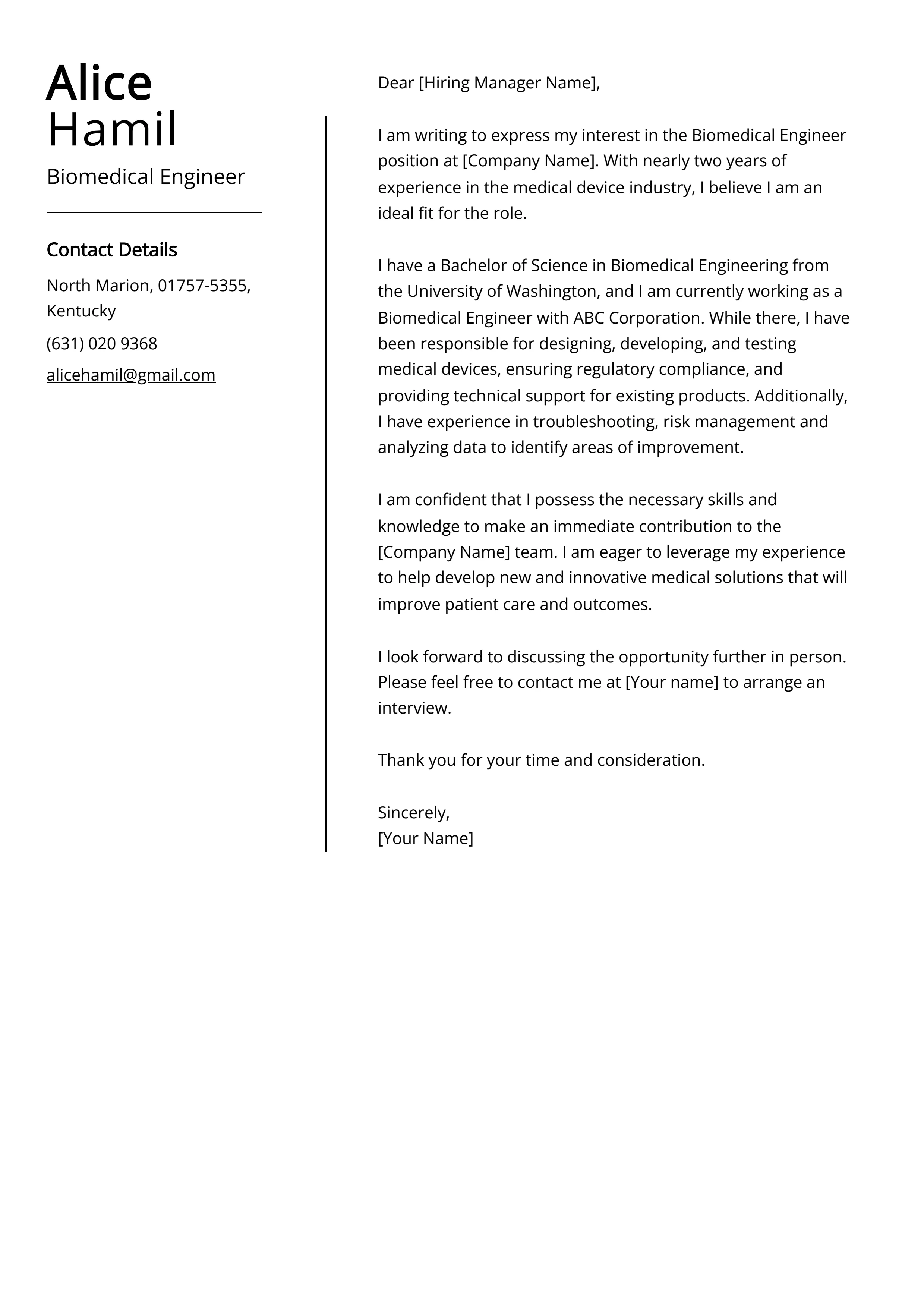
Crafting a Compelling Biomedical Engineer Cover Letter
A well-crafted cover letter is your first impression on a potential employer, and for a Biomedical Engineer, it’s crucial to showcase your expertise and passion for the field. Your cover letter needs to go beyond simply listing your qualifications; it needs to tell a story of why you are the perfect fit for the role and the company. This guide will walk you through each step, ensuring your cover letter stands out and gets you noticed. Remember, the goal is to secure an interview, and a strong cover letter is your key to unlocking that opportunity.
Understanding the Biomedical Engineering Field
Before you begin writing, it is crucial to understand the scope of Biomedical Engineering. This field is the application of engineering principles to the fields of biology and medicine. This includes designing and building medical devices, developing new therapies, and conducting research to improve human health. Knowing these aspects will assist you in tailoring your letter in a manner that is suitable for the job you’re applying for, highlighting your relevant knowledge.
Key Responsibilities of Biomedical Engineers

Biomedical engineers often have diverse responsibilities. This includes designing and developing medical devices, such as prosthetics, diagnostic equipment, and surgical instruments. They might also be involved in research, clinical trials, and regulatory compliance. Your cover letter should demonstrate an awareness of these duties and highlight the specific areas where your experience and skills align with the job description. Mention your relevant software skills such as SolidWorks, AutoCAD, MATLAB or other design software.
Highlighting Your Skills and Experience
Your cover letter should showcase your skills and experience in a way that is relevant to the job description. Do not just list them; provide specific examples of how you have applied these skills and the results you achieved. This will make your application more engaging and help the hiring manager understand the value you bring to the table. Providing quantifiable results will demonstrate the impact of your work.
Technical Skills to Showcase
Biomedical engineers often possess a wide range of technical skills. Consider listing your specific expertise, such as experience with medical device design, biomaterials, biomechanics, or instrumentation. Be sure to use keywords from the job description when applicable. If the job posting mentions experience with a specific type of equipment or software, highlight your experience with them. This will show the hiring manager that you have the necessary technical aptitude for the role.
Relevant Software Proficiency

Many biomedical engineering roles require proficiency in specific software applications. These might include CAD software, simulation tools, or statistical analysis software. Make sure to list your software skills in your cover letter, including the specific software names. If you have experience using software for a particular purpose (e.g., designing medical devices or analyzing clinical data), mention it in your cover letter.
Laboratory and Research Experience
If you have laboratory or research experience, emphasize it. Describe your role in the lab, the types of experiments you conducted, and any results you achieved. Also, highlight any publications or presentations you have made. This shows potential employers that you have practical experience, as well as a solid foundation in the scientific method. This is especially important for positions that involve research and development.
Quantifying Achievements
Whenever possible, quantify your achievements. Instead of saying you ‘improved efficiency,’ say you ‘increased efficiency by 15%’. Use numbers and data to illustrate your impact. Provide concrete examples of your contributions. This makes your accomplishments more believable and demonstrates your ability to make a positive difference in a new role. Include specifics like reducing costs, saving time, or improving outcomes.
Tailoring Your Cover Letter to the Job

A generic cover letter will not impress potential employers. You should customize each cover letter to the specific job and company you are applying for. This requires you to research the company, the role, and the hiring manager. This shows your commitment to the specific opportunity. Furthermore, you should match your skills and experience to the job requirements, using keywords from the job description.
Researching the Company and the Role
Before writing your cover letter, research the company. Understand their mission, values, and recent projects. Visit the company website, read news articles, and check out their social media profiles. Investigate the specific role as well. Examine the job description closely to fully understand the requirements and the desired skills. This information will help you to tailor your cover letter and demonstrate your enthusiasm for the opportunity.
Matching Skills to Job Requirements
Carefully review the job description and identify the key skills and qualifications the employer is seeking. Then, in your cover letter, highlight the skills and experiences that match those requirements. Use the same terminology as the job description. If a job posting mentions ’experience with medical imaging,’ make sure to include a section in your letter addressing your specific expertise in that area. This focused approach makes it easier for the hiring manager to see how your skills align with their needs.
Using Keywords Effectively

Many companies use Applicant Tracking Systems (ATS) to screen cover letters and resumes. These systems scan your documents for keywords. Therefore, you must include keywords from the job description in your cover letter. Incorporate these keywords naturally. Avoid simply listing them; use them in sentences that describe your skills and experiences. This will help your cover letter pass through the ATS and reach the hiring manager.
Formatting and Structure for Impact
The formatting of your cover letter can significantly impact how it is received. You should use a professional and easy-to-read format, ensuring your cover letter looks neat and organized. Additionally, carefully structure your letter to make it easy for the reader to find the information. You should include clear headings and concise paragraphs.
Header and Contact Information
Start your cover letter with your contact information. Include your name, address, phone number, and email address. You should also include the date and the name and address of the hiring manager and the company. Ensure your contact information is up-to-date and professional. Make sure your email address sounds professional as well.
Professional Salutations and Tone

Use a professional salutation, such as ‘Dear Mr./Ms./Mx. [Last Name]’. If you do not know the hiring manager’s name, use ‘Dear Hiring Manager’. Maintain a professional tone throughout your cover letter. Your tone should be enthusiastic and confident but also respectful. Avoid slang and jargon. Your writing should be clear, concise, and easy to read.
Body Paragraph Strategies
The body of your cover letter is where you can truly make an impression. Structure your letter with clear and focused paragraphs. You should follow a format that presents information in a logical manner. Begin with an introduction that grabs the reader’s attention. Then, move on to highlight your skills and experiences, and close with a paragraph that expresses your enthusiasm and fit for the role.
The Introduction Paragraph
The introduction is your opportunity to grab the reader’s attention. State the position you are applying for and where you found the job posting. Then, make a brief statement that highlights your most relevant qualifications and why you are interested in the position and the company. Make sure your introduction is concise and immediately relevant to the job.
The Skills and Experience Paragraph

This is where you showcase your skills and experiences. Briefly describe your relevant skills and provide specific examples that illustrate your accomplishments. Quantify your achievements whenever possible. Refer to your resume to support your claims. The skills and experiences you list should directly address the job requirements.
The Enthusiasm and Company Fit Paragraph
In this paragraph, demonstrate your enthusiasm for the position and the company. Explain why you are interested in the opportunity and what attracts you to the company. Mention something specific that excites you about the role or the company’s work. This shows the hiring manager that you have done your research and that you are genuinely interested in the opportunity. You want to show that you are not just seeking any job, but this particular job.
Concluding Your Cover Letter
End your cover letter with a strong call to action. Thank the hiring manager for their time and consideration. Reiterate your interest in the position. Then, include a statement indicating that you look forward to the opportunity to discuss your qualifications further. Finish with a professional closing such as ‘Sincerely’ or ‘Best regards,’ followed by your name.
Proofreading and Editing for Perfection
Before you submit your cover letter, proofread it carefully. Check for any grammatical errors, spelling mistakes, and typos. Additionally, have someone else read it over as a second set of eyes can catch errors you might have missed. A polished cover letter shows professionalism and attention to detail.
Common Mistakes to Avoid
Avoid generic cover letters that could be sent to any company. Do not use clichés or overly formal language. Do not include information irrelevant to the job. Ensure that your cover letter is error-free and well-organized. Make sure that you use keywords to pass the ATS.
Seeking Feedback Before Submitting
Ask a trusted friend, mentor, or career counselor to review your cover letter before you submit it. They can provide valuable feedback on its clarity, content, and overall effectiveness. Ask them to check the formatting and to ensure it flows well. Listen to their suggestions and make any necessary revisions. Getting feedback can help you improve your cover letter and increase your chances of getting an interview.