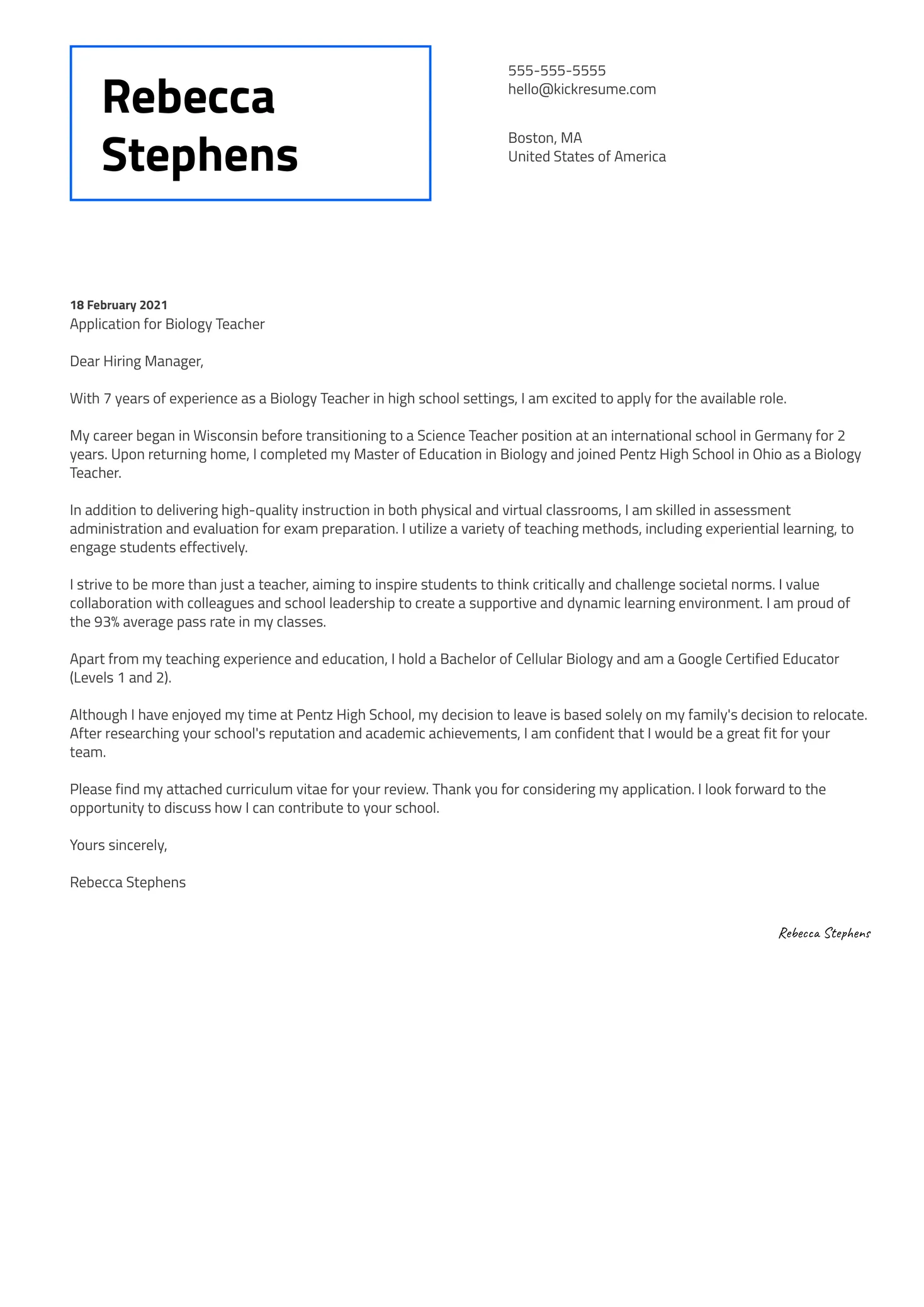
What is a Biology Teacher Cover Letter
A Biology Teacher Cover Letter is a crucial document that accompanies your resume when applying for teaching positions. It serves as your introduction to the hiring committee, providing a concise overview of your qualifications, skills, and experience in the field of biology education. Unlike a resume, which lists facts and figures, a cover letter allows you to showcase your personality, enthusiasm, and teaching philosophy. It’s your chance to make a compelling case for why you’re the ideal candidate for the job. The cover letter should be tailored to each specific position, highlighting the aspects of your background that align with the school’s needs and values. Think of it as a personalized sales pitch, designed to persuade the reader to invite you for an interview.
Why is a Cover Letter Important for Biology Teachers
The importance of a cover letter for a biology teacher cannot be overstated. Firstly, it provides context to your resume. While your resume outlines your skills and experience, your cover letter explains how those attributes make you a good fit for the specific role and school. Secondly, it demonstrates your communication skills. A well-written cover letter showcases your ability to articulate your thoughts clearly and persuasively, a vital skill for any educator. Moreover, it gives you the opportunity to express your passion for biology and your commitment to education. This can set you apart from other applicants who might have similar qualifications but fail to convey their enthusiasm. Finally, a cover letter shows that you are proactive and take the application process seriously. It indicates that you’ve taken the time to research the school and tailor your application to their specific needs. In a competitive job market, a strong cover letter can be the deciding factor in securing an interview.
Key Elements of a Biology Teacher Cover Letter

A successful Biology Teacher Cover Letter includes several key elements. First, it must contain your contact information, including your name, address, phone number, and email address. Following this, address the letter to the hiring manager, if possible. Next, start with an engaging opening paragraph that grabs the reader’s attention. Then, highlight your qualifications and skills, emphasizing your relevant education, certifications, and teaching experience. Showcase your passion for biology and your teaching philosophy, and use action verbs and quantifiable results to demonstrate your accomplishments. Be sure to tailor your letter to the specific job description and school or district. Finally, format the letter professionally, proofreading it carefully for any errors, and conclude with a strong closing paragraph that expresses gratitude and outlines your next steps.
Your Contact Information
Begin your cover letter by including your full name, address, phone number, and professional email address. Ensure your contact information is accurate and up-to-date. This information should be clearly presented at the top of the letter, allowing the hiring manager to easily reach you if they decide to move forward with your application. Use a font size that is easy to read and maintain a professional appearance. Double-check your email address for any typos, as this is a common oversight that could hinder communication. Make sure your voicemail is set up and ready to accept messages.
Hiring Manager Details
Whenever possible, address your cover letter to a specific person. Research the school’s website or contact the human resources department to find the name of the hiring manager or the person responsible for reviewing applications. Addressing the letter directly to an individual demonstrates your attention to detail and your genuine interest in the position. If you are unable to find a specific name, you can use a general salutation like “Dear Hiring Committee” or “Dear [School Name] Hiring Manager.” Avoid using generic greetings like “To Whom It May Concern,” as they can make your application appear less personalized. This personal touch can make a significant difference in making your cover letter stand out.
Greeting the Hiring Manager

The greeting sets the tone for your entire letter. A professional greeting, such as “Dear Mr./Ms./Mx. [Last Name]” or “Dear Hiring Manager,” is essential. Use the appropriate title (Mr., Ms., or Mx.) based on your research or the information available. Ensure you spell the name correctly. If you are unsure of the correct title or spelling, it’s better to use a more general salutation than to make an error. Your greeting should be followed by a comma. This small detail demonstrates your attention to detail and respect for the recipient, which can positively impact how your cover letter is received.
The Opening Paragraph: Grab Attention
The opening paragraph is your opportunity to capture the hiring manager’s attention. Start with a strong, engaging statement that immediately grabs their interest. This could be a brief summary of your key qualifications or an enthusiastic expression of your interest in the position and the school. Clearly state the position you are applying for and where you saw the job posting. Avoid generic opening lines. Instead, demonstrate your enthusiasm for the specific opportunity. Consider mentioning something specific about the school or its biology program that resonates with you. This personalization shows that you’ve done your research and are genuinely interested in the role.
Highlighting Your Qualifications & Skills
In the body of your cover letter, highlight your relevant qualifications and skills. This section should provide a deeper look into your abilities as a biology teacher. Emphasize the aspects of your background that align with the job description. Include details about your education, certifications, teaching experience, and any special skills or achievements. Your goal is to convince the hiring manager that you have the knowledge, skills, and experience necessary to excel in the role. Use specific examples to illustrate your qualifications. Focus on how you can meet the needs of the school and contribute to its biology program. The information should be clear, concise, and easy to follow, reinforcing the strengths you bring to the table.
Relevant Education and Certifications

Clearly state your educational background, including your degrees, majors, and any relevant coursework. Specify the institution and the year of graduation. If you have a Master’s or Doctorate in biology or a related field, be sure to mention it prominently. List any teaching certifications or licenses you hold, specifying the state and subject areas covered. Mention any advanced training or professional development courses you’ve completed, particularly those related to biology education, such as specific teaching methodologies or curriculum development. Provide details that highlight your preparedness and commitment to professional growth. Include any other relevant academic achievements such as honors, awards, or publications.
Teaching Experience and Achievements
Describe your teaching experience, including the schools or institutions where you’ve worked, the grade levels and subjects you’ve taught, and the duration of your employment. Focus on your accomplishments and the impact you’ve made on your students. Use specific examples to illustrate your successes, such as improved student test scores, successful implementation of new teaching methods, or any awards or recognition you’ve received. Quantify your achievements whenever possible. For example, “Increased student test scores by 15%.” Highlight any innovative teaching strategies you’ve implemented, like the use of technology, hands-on experiments, or project-based learning. Mention any extracurricular activities you’ve been involved with, such as science clubs or tutoring programs, to demonstrate your commitment to student success.
Showcasing Your Passion for Biology
Express your enthusiasm for biology and your love for teaching. This is your chance to demonstrate your genuine interest in the subject. Describe why you are passionate about biology and what excites you about sharing your knowledge with students. Share specific examples of how you instill a love of science in your students. Mention any personal interests or hobbies related to biology, such as fieldwork, research, or science communication. This can make you stand out from other candidates. Connect your passion for biology to your teaching philosophy and explain how you inspire students to explore and appreciate the natural world. Convey your commitment to providing an engaging and enriching learning experience.
Emphasize Your Teaching Philosophy

Describe your teaching philosophy and how you approach the educational process. Explain your beliefs about effective teaching and learning. Do you prioritize inquiry-based learning, hands-on activities, or student-centered instruction? Share your approach to classroom management, student assessment, and differentiation. Highlight your ability to create a positive and inclusive learning environment. Mention your approach to incorporating technology and other resources. Show how you foster critical thinking, problem-solving skills, and a love for learning in your students. This section provides insights into your teaching style and how you create engaging lessons. It helps the hiring manager assess whether your approach aligns with the school’s values.
Use Action Verbs & Quantifiable Results
Use action verbs to describe your accomplishments and responsibilities, such as “developed,” “implemented,” “managed,” “created,” “led,” and “achieved.” Action verbs make your descriptions more dynamic and engaging. Wherever possible, include quantifiable results to demonstrate the impact of your actions. For instance, instead of saying “Improved student performance,” say “Improved student performance by 20% on standardized tests.” Use data, statistics, and specific examples to illustrate your achievements. This is a concrete way to show the value you bring to the position. This approach adds credibility and gives the hiring manager a clear understanding of your successes.
Tailoring Your Letter to the Specific Job
Tailor your cover letter to each specific job you apply for. The hiring committee can tell when a cover letter is generic and mass-produced. Customizing your letter shows that you have taken the time to understand the requirements of the position and the values of the school. This includes highlighting the skills and experiences that align with the specific job description. Also, include mentioning any unique aspects of your experience that match the school’s needs. Tailor your letter to show how you can fulfill their specific needs and contribute to the school’s overall success.
Research the School or District

Before you write your cover letter, research the school or district where you are applying. Visit their website, read about their mission and values, and look for information about the biology program. This will help you align your cover letter with the school’s priorities. Identify any specific initiatives, programs, or goals that are relevant to your experience. Understanding the school’s culture and needs will allow you to tailor your application and demonstrate that you understand the unique aspects of their institution. Showing that you have researched the school demonstrates your genuine interest in the position and improves your chances of getting an interview.
Address Specific Needs or Requirements
Carefully read the job description and identify the key requirements and qualifications. Then, highlight the skills and experiences you have that directly address those needs. If the job description emphasizes specific skills or knowledge areas, make sure to mention them prominently in your cover letter. For example, if the job description mentions the need for experience with a particular curriculum or technology, highlight your proficiency in those areas. In your cover letter, explicitly connect your qualifications to the job requirements. This will show the hiring manager that you understand what they’re looking for and that you possess the skills and experience needed to succeed in the role.
Formatting and Proofreading
Formatting and proofreading are crucial for creating a professional and polished cover letter. Formatting refers to the layout and design of your letter. Proofreading involves checking for grammatical errors, spelling mistakes, and typos. Both are essential to making a positive impression on the hiring manager. Ensure that your cover letter is easy to read, visually appealing, and free of errors. A well-formatted and carefully proofread cover letter demonstrates your attention to detail and commitment to professionalism. A poorly formatted or error-filled cover letter could lead to your application being rejected before it is even read.
Font Choice and Readability

Choose a professional and easy-to-read font, such as Times New Roman, Arial, or Calibri. Keep the font size between 10 and 12 points for optimal readability. Use consistent formatting throughout your cover letter. Maintain a clean and uncluttered layout with adequate white space between paragraphs and sections. Use bolding, italics, and underlining sparingly. Ensure the letter is well-structured with clear headings and subheadings to guide the reader. Avoid using overly creative or elaborate fonts that could distract from the content. The goal is to create a visually appealing document that highlights your qualifications and accomplishments.
Proofread for Errors
Carefully proofread your cover letter for any spelling, grammar, and punctuation errors. Mistakes can undermine your credibility and make you appear unprofessional. Use a spell checker and grammar checker, but don’t rely on them entirely. Read the letter aloud to catch any awkward phrasing or sentence structures. Ask a friend, family member, or career counselor to review your cover letter for errors. Ensure your letter is free of typos, grammatical errors, and inconsistencies. Check for correct capitalization, punctuation, and spacing. A polished and error-free cover letter will help you make a strong impression and enhance your chances of getting an interview.
The Closing Paragraph & Call to Action
In your closing paragraph, express your gratitude for the hiring manager’s time and consideration. Reiterate your interest in the position and summarize why you are the best candidate. Include a call to action, inviting the hiring manager to contact you for an interview. Provide your phone number and email address again to make it easy for them to reach you. End with a professional closing, such as “Sincerely,” “Respectfully,” or “Best regards,” followed by your typed name. This closing should be followed by a signature, either a handwritten one if you’re sending a printed copy or an electronic one if you’re submitting the letter digitally. This final step reinforces your professionalism.
Expressing Gratitude and Next Steps

Express your appreciation for the hiring manager’s time and the opportunity to be considered for the position. Restate your interest in the job and the school. Summarize your key qualifications and reiterate why you are the best fit for the role. Clearly state your availability for an interview. Provide your phone number and email address again. Thank the hiring manager for their time. End with a professional closing, such as “Sincerely,” “Respectfully,” or “Best regards,” followed by your typed name. This final step reinforces your professionalism and demonstrates your enthusiasm for the position.