Understanding the Importance of an Accounting Job Cover Letter
In the competitive world of accounting, a well-crafted cover letter is your first opportunity to make a lasting impression. It’s more than just a formality; it’s a critical tool that can significantly increase your chances of landing an interview. Your resume provides a snapshot of your qualifications, but the cover letter offers a chance to elaborate on those qualifications, demonstrate your personality, and express your genuine interest in the specific role and company. When applying for an accounting job, a cover letter allows you to showcase your understanding of the company’s needs and explain why you are the ideal candidate. Without a compelling cover letter, even a strong resume may be overlooked. This introduction sets the stage for a successful job application.
Why a Cover Letter is Crucial
The cover letter serves several vital functions in the job application process. First and foremost, it personalizes your application. Generic applications are easily dismissed by hiring managers. A cover letter allows you to speak directly to the hiring manager, tailoring your message to the specific requirements of the job and the company’s values. It provides a space to explain any gaps in your employment history or address any concerns a recruiter might have. Moreover, a strong cover letter demonstrates your communication skills, a vital asset in any accounting role. It showcases your ability to articulate your thoughts clearly and concisely, which is essential for tasks such as preparing financial reports, communicating with clients, and collaborating with colleagues. A well-written cover letter sets you apart from other candidates.
Highlighting Your Skills and Experience

Your cover letter should act as a bridge between your resume and the job description, carefully selecting skills and experiences that align with the position’s requirements. Begin by reviewing the job posting meticulously. Identify the key skills and qualifications the employer is seeking. These could include technical skills like proficiency in accounting software (e.g., QuickBooks, SAP), experience with financial analysis, knowledge of GAAP (Generally Accepted Accounting Principles), or skills in budgeting and forecasting. Also, highlight soft skills such as attention to detail, analytical thinking, problem-solving abilities, and excellent communication skills. When describing your experience, use the STAR method (Situation, Task, Action, Result) to provide specific examples of how you have demonstrated these skills in past roles. For example, instead of saying “Managed accounts payable,” you could say “In my role at XYZ Company, I managed the accounts payable process, reducing late payment fees by 15% through improved vendor relations and streamlined processes.”
Tailoring Your Cover Letter to the Job Description
A generic cover letter is a sure way to end up in the rejection pile. Each cover letter should be customized to the specific job you are applying for. Start by thoroughly reading the job description to understand the role’s responsibilities and the company’s expectations. Then, identify the key requirements and tailor your cover letter to highlight your relevant skills and experiences. For instance, if the job description emphasizes experience with a particular accounting software, make sure to mention your proficiency with that software in your cover letter and provide specific examples of how you’ve used it. If the job requires strong communication skills, provide an instance where you successfully communicated complex financial information to non-financial stakeholders. By showing that you understand the job’s specific requirements and demonstrating how your skills and experience align with those needs, you can make a strong case for why you should be considered for the position. This level of personalization demonstrates to the hiring manager that you are genuinely interested in the role and have taken the time to understand their needs.
Researching the Company
Before you start writing your cover letter, take some time to research the company. Understanding the company’s mission, values, and recent accomplishments can help you tailor your letter to show genuine interest and make a positive impression. Visit the company’s website, review their social media profiles, and read any recent press releases or news articles. This research will help you understand the company’s culture, its current projects, and its goals. Use this information to demonstrate how your skills and experience align with the company’s specific needs and values. For example, if the company emphasizes innovation or sustainability, you can highlight any experience you have in those areas. Showing that you’ve taken the time to learn about the company demonstrates your enthusiasm and commitment, which can set you apart from other applicants. It also provides you with talking points for the interview, if you get one, showing that you are prepared and eager to contribute.
Key Components of an Effective Accounting Cover Letter

A well-structured cover letter consists of several key components, each designed to enhance your chances of success. Firstly, start with your contact information and the date. This information should be aligned to the left, including your name, address, phone number, and email. Following this, include the date you are writing the letter. Next, include the hiring manager’s name, title, and the company’s address if you know it. The introductory paragraph is your first opportunity to grab the hiring manager’s attention. Briefly state the position you are applying for and where you found the job posting. Express your enthusiasm for the role and the company, and quickly highlight one or two key qualifications that make you a strong fit. The body paragraphs are where you elaborate on your skills and experience. Provide specific examples and quantify your accomplishments whenever possible. Use the STAR method to demonstrate how you have used your skills in past roles. Finally, the closing paragraph should summarize your interest in the position and reiterate your qualifications. Include a call to action, such as expressing your eagerness for an interview.
Contact Information and Date
The top of your cover letter sets the tone for the rest of the document, so it’s important to get this section right. Begin by including your contact information, which should be left-aligned. This typically includes your full name, address, phone number, and a professional-looking email address. Make sure your email address is professional; avoid using nicknames or unprofessional language. Below your contact information, include the date you are writing the letter. After that, if you know the hiring manager’s name, include their name, title, and the company’s address (right-aligned is also acceptable). If you are unsure of the hiring manager’s name, you can use a generic greeting such as “Dear Hiring Manager.” Accurate contact information shows attention to detail, a crucial skill in accounting, as well as making it easy for the employer to reach you.
The Introductory Paragraph
The introductory paragraph is your first chance to make a strong impression on the hiring manager. This paragraph should be concise, engaging, and directly state the purpose of your letter: applying for the accounting job. Start by mentioning the specific position you are applying for and where you found the job posting (e.g., “I am writing to express my interest in the Accounting position advertised on LinkedIn”). Show your enthusiasm for the role and the company, but keep it brief. Highlight one or two key qualifications that make you a good fit for the job. For example, you might mention your years of experience in financial analysis or your proficiency with a specific accounting software. The introductory paragraph should set the stage for the rest of your letter by capturing the reader’s attention and signaling your interest in the position.
Body Paragraphs Skills and Achievements

The body paragraphs are the core of your cover letter, where you elaborate on your skills, experience, and achievements. Use these paragraphs to demonstrate how your qualifications align with the job requirements. Instead of simply listing your skills, provide specific examples and quantify your achievements whenever possible. For example, instead of saying “Experienced in financial reporting,” you could say “Prepared monthly financial reports, which resulted in a 10% improvement in reporting accuracy.” Use the STAR method (Situation, Task, Action, Result) to provide context and show how you have used your skills in past roles. In the Situation, briefly describe the context. In the Task, explain your responsibilities. In the Action, detail what you did to accomplish the task. In the Result, highlight the positive outcome of your actions. This approach helps the hiring manager visualize your capabilities and understand your value as a potential employee.
Quantifiable Accomplishments
To make your cover letter stand out, always include quantifiable achievements. Numbers and metrics provide concrete evidence of your abilities and the impact you have made in previous roles. Whenever possible, use data to support your claims. Instead of saying “Improved efficiency,” say “Improved process efficiency by 15% through the implementation of new software.” Other examples include “Reduced accounting errors by 20%,” “Managed a budget of $X million,” or “Processed X number of invoices per month with 99% accuracy.” These specific examples will help demonstrate your value to the company and provide the hiring manager with tangible proof of your skills. Ensure your claims are accurate and verifiable, as exaggeration can undermine your credibility. Focus on achievements that are relevant to the job description and the company’s goals.
The Closing Paragraph and Call to Action
The closing paragraph is your last opportunity to make an impression, so make sure to use it effectively. Summarize your interest in the position and reiterate your key qualifications. Thank the hiring manager for their time and consideration. Also, include a clear call to action. This can be a statement such as “I am eager to discuss how my skills and experience can benefit your team” or “I am available for an interview at your earliest convenience.” Make sure the call to action is polite but assertive. Close the letter with a professional closing, such as “Sincerely” or “Best regards,” followed by your full name. The closing paragraph provides a final opportunity to create a positive impression and increases the likelihood of receiving an interview. The final sentences could be: “Thank you for considering my application. I am eager to learn more about this opportunity and discuss how my skills can contribute to your team. I look forward to hearing from you soon.”
Proofreading and Formatting Your Cover Letter

Before submitting your cover letter, it is essential to proofread and format it carefully. Proofreading ensures that your letter is free of any grammatical errors, spelling mistakes, and typos. Errors can undermine your professionalism and create a negative impression, so take the time to review your work meticulously. Reading the letter aloud can help you catch mistakes that you might miss otherwise. It is helpful to have someone else review your letter as well, as a fresh pair of eyes can often spot errors that you have overlooked. Formatting your cover letter appropriately also makes it easier to read and presents a professional image. Use a clear and readable font, such as Times New Roman or Arial, and keep the font size between 10 and 12 points. Use consistent formatting throughout, including margins, spacing, and bullet points. Ensure that your cover letter is easy to read and visually appealing, as it will make a positive impact on the hiring manager.
Common Mistakes to Avoid
Avoid making common mistakes that can hurt your chances of landing an interview. One of the most significant errors is ignoring the job description. Failing to tailor your cover letter to the specific requirements of the job shows that you are not interested in the role and have not taken the time to understand the company’s needs. Another mistake is sending a generic cover letter. Generic letters lack personalization and do not demonstrate your genuine interest in the company and the position. These types of letters are often seen as impersonal and quickly discarded. Moreover, issues with length and formatting can be detrimental. Keep your cover letter concise, ideally no more than one page. Make sure your formatting is consistent, using clear fonts and appropriate spacing. Avoid including excessive information or overly long paragraphs, as they can make your letter difficult to read.
Ignoring the Job Description
One of the most significant mistakes you can make when writing a cover letter is ignoring the job description. The job description is the blueprint for the role and outlines the skills, experience, and qualifications the employer is looking for. Failing to address the specific requirements listed in the job description shows a lack of attention to detail and a lack of genuine interest in the position. Carefully read the job description, noting the key responsibilities, required skills, and any specific qualifications mentioned. Then, tailor your cover letter to highlight how your skills and experience align with these requirements. Include relevant keywords and phrases from the job description, but avoid simply repeating the text. Instead, provide specific examples of how you have demonstrated those skills in past roles and show the results you achieved. Customizing your cover letter to the job description shows the hiring manager that you have taken the time to understand the position and are a good fit.
Generic Cover Letters

A generic cover letter is a major red flag for hiring managers. Generic cover letters are impersonal, lack specific details, and demonstrate a lack of genuine interest in the specific role and company. These cover letters often sound like they could be sent to any company for any job. They do not take the time to demonstrate an understanding of the company’s values or the specific requirements of the role. To avoid this mistake, always customize your cover letter for each job you apply for. Research the company, understand the role’s responsibilities, and tailor your letter to address those aspects. Highlight the specific skills and experiences that are relevant to the job. Show enthusiasm for the company and explain why you are a good fit for their culture. By taking the time to personalize your cover letter, you will create a strong impression, set yourself apart from other applicants, and significantly increase your chances of an interview.
Length and Formatting Issues
Length and formatting issues can also detract from your cover letter. Ideally, your cover letter should be concise, typically no more than one page. Hiring managers are busy and may not have time to read a lengthy document. Keep your paragraphs brief and focused. Use a clear and professional font, such as Times New Roman or Arial, and maintain a font size between 10 and 12 points. Ensure your formatting is consistent throughout the document. Use appropriate margins, spacing, and bullet points to make the letter easy to read. Avoid using excessive formatting, such as multiple font styles or colors, which can distract the reader. A well-formatted cover letter is professional and easy to read, demonstrating that you have attention to detail, which is critical in the accounting field.
Example of a Successful Accounting Cover Letter
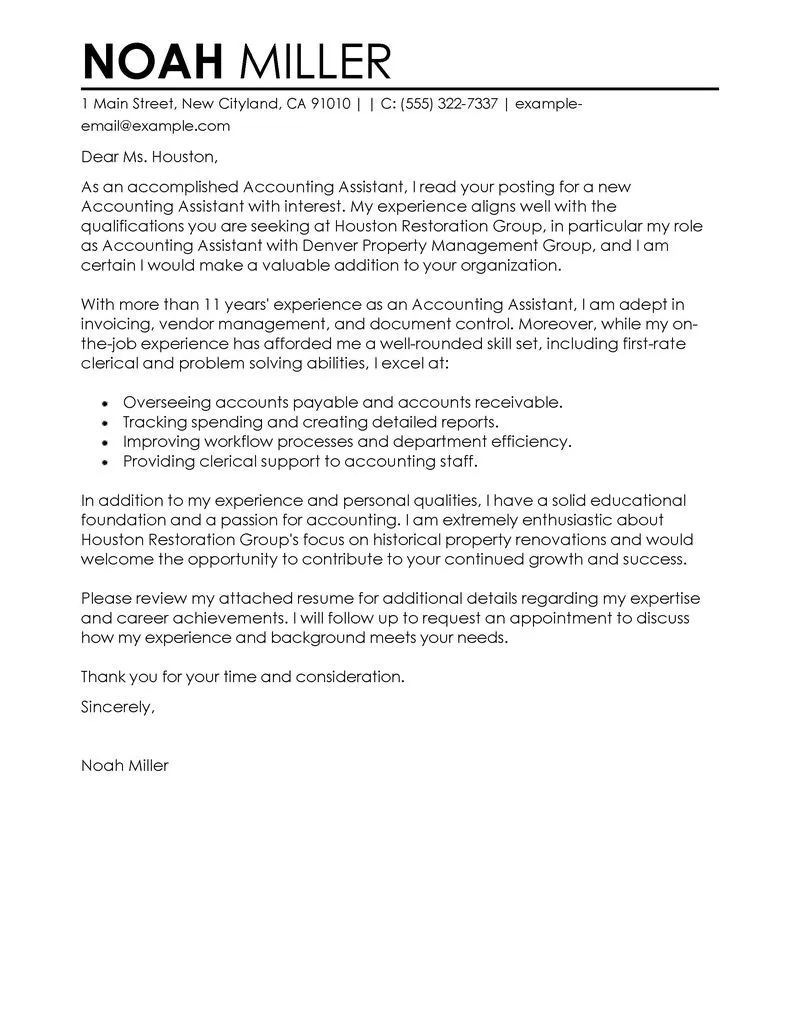
To get a better idea, see below an example of a successful accounting cover letter.
[Your Name] [Your Address] [Your Phone Number] [Your Email Address]
[Date] [Hiring Manager Name] [Hiring Manager Title] [Company Name] [Company Address]
Dear [Hiring Manager Name],
I am writing to express my keen interest in the Staff Accountant position at [Company Name], as advertised on [Platform where you saw the job posting]. With over five years of experience in accounting and a strong track record of accuracy and efficiency, I am confident that my skills and expertise align perfectly with the requirements of this role.
In my previous role at [Previous Company], I was responsible for preparing monthly financial statements, managing accounts payable and receivable, and assisting with budget preparation. I successfully streamlined the accounts payable process, which resulted in a 10% reduction in late payment fees. I am proficient in accounting software such as QuickBooks and have a solid understanding of GAAP.
I am particularly drawn to [Company Name] because of [mention something specific about the company that interests you, e.g., its commitment to innovation, its values, its products/services]. I am eager to contribute my skills and experience to your team and help [Company Name] achieve its financial goals.
Thank you for considering my application. I have attached my resume for your review and welcome the opportunity to discuss my qualifications in an interview. I look forward to hearing from you soon.
Sincerely, [Your Name]
Remember to tailor the example above to your specific skills, experience, and the job you are applying for. Replace the bracketed information with your details and the specific details of the role and the company. This will boost your chance of getting hired!